
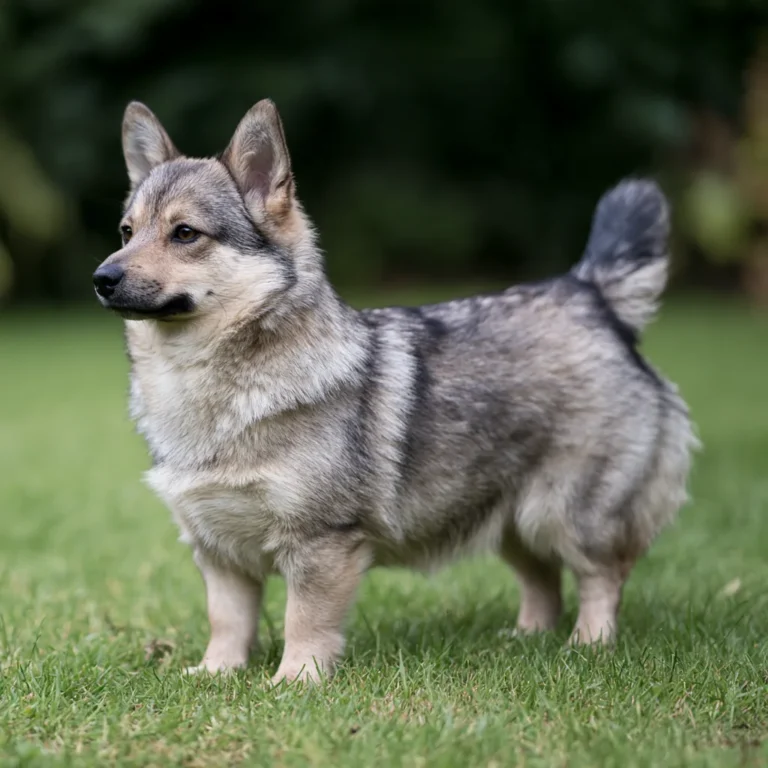
No Swedish Vallhund stud dogs are listed right now
One breeder lists the Swedish Vallhund. Ask them if they have a stud dog.
Swedish Vallhund breeders
- Swedish VallhundSpecialities: not listed yet
Thorjakker Swedish Vallhunds
Hemel Hempstead, Hertfordshire

Do you breed the Swedish Vallhund? Add a stud dog free.
Using a Swedish Vallhund stud dog
Choosing a Swedish Vallhund stud dog starts with his health results: a retinopathy DNA result, an eye examination under the BVA/KC/ISDS Eye Scheme and a score under the BVA/KC Hip Dysplasia Scheme, all of which you can confirm on the RKC Health Test Results Finder. Retinopathy is inherited as a recessive trait, so a stud with no copies of the MERTK insertion cannot sire puppies with two copies, even from a carrier bitch, although some puppies may be carriers. Confirm both dogs' registrations and that neither carries an endorsement stopping the litter being registered. The Kennel Club's health plan found one dog had sired nearly a quarter of puppies registered in 2015–19, so consider less-used sires and check the pairing on the RKC inbreeding coefficient calculator (the tool breeders knew as Mate Select), aiming at or below the breed average. Agree the fee and terms in writing.
Health tests for a Swedish Vallhund stud
The Swedish Vallhund Society regards the breed as generally hardy, and names hip dysplasia and retinopathy as the main problems it can be prone to. The breed's health co-ordinator ranked the same two conditions as priorities, and so did the Kennel Club's breed health and conservation plan.
Retinopathy in the Vallhund is a progressive degeneration of the retina. A 2017 study linked it strongly to an insertion in the MERTK gene: dogs with two copies had roughly a twenty-fold higher risk, the study found no evidence of extra risk in dogs with one copy, and signs first appeared at anything from about one to over twelve years of age. Because the disease can show late, a dog may be bred from before any change is seen, so the breed aims to DNA test all breeding stock as well as eye examining it. The Kennel Club formally recognised the DNA test in March 2017. The breed is also listed for PRA on the BVA Eye Scheme's 2026 list of inherited eye diseases.
Hips can be X-rayed and scored from one year of age, and the BVA advises breeding from dogs scoring below or close to the breed median.
On Breed Watch the Swedish Vallhund is Category 1: no breed-specific points of concern have been flagged for judges.
Tests and schemes the RKC lists for the breed
- Good practice: prioritising genetic diversity
- Best practice: DNA test for retinopathy
- Best practice: eye testing using the BVA/KC/ISDS Eye Scheme
- Best practice: hip testing (for hip dysplasia) using the BVA/KC Hip Dysplasia Scheme
More for Swedish Vallhund owners and breeders
- Swedish Vallhund: breeders
- Swedish Vallhund: puppies for sale
- Swedish Vallhund: stud dogs
- All Pastoral group breeds
Official sources
- Swedish Vallhund breed information u2013 The Royal Kennel Club
- Swedish Vallhund breed standard u2013 The Royal Kennel Club
- The Swedish Vallhund Society
- Health u2013 The Swedish Vallhund Society
- Swedish Vallhund Breed Health and Conservation Plan (Kennel Club, PDF hosted by the Swedish Vallhund Society)
- DNA test u2013 Retinopathy u2013 The Royal Kennel Club
- Hip Scheme u2013 BVA Canine Health Schemes
- Eye Scheme u2013 BVA Canine Health Schemes
- Health Test Results Finder u2013 The Royal Kennel Club
- Inbreeding coefficient calculator u2013 The Royal Kennel Club