Advertise your Bernese Mountain Dog puppies, litters and stud dogs
Breeding Bernese Mountain Dogs? Add your kennel to caninebreeder.co.uk so that buyers looking for Bernese Mountain Dog puppies for sale can find you by name and location. Your basic listing shows your kennel or company name, website, social media, address and categories. When you have a litter, advertise Bernese puppies for sale alongside your hip and elbow results, and if you keep a Bernese Mountain Dog stud dog, list him with his health tests and COI so other breeders can assess him. Create your listing.
No breeders are listed here yet, so the first profiles get the page to themselves.
- Free basic profile: your breeder or company name, website, social media, location, breeds and industries.
- Litters and stud dogs advertised in their own sections, never mixed with puppies for sale.
- Premium showcase for your services and prices, previous customers, awards, video, gallery and health certificates, with your phone and email shown to buyers.
- Sponsored articles about your breed or industry, written and published by our team.
- Featured placement at the top of this page, labelled as sponsored.
Is it free to advertise here?
Yes. A breeder profile and your litter and stud dog adverts are free. Premium profiles, featured placement and sponsored articles are optional paid extras; see pricing.
Do I need a licence to advertise puppies?
In England you need a dog breeding licence from your council if you breed three or more litters in 12 months or breed and sell dogs as a business, and Wales, Scotland and Northern Ireland have their own schemes. Licensed breeders show their licence number and issuing council on every advert. Puppies must be at least eight weeks old before they go to new homes.
Is my listing already here?
We add licensed breeders from councils' public registers. Search for your kennel name; if it is listed you can claim it and edit everything.
About the Bernese Mountain Dog
The Bernese Mountain Dog comes from the canton of Berne in Switzerland, where it was first called the Dürrbachhund after the Dürrbach area near Riggisberg. The breed club's history describes an all-purpose working dog that pulled farmers' loaded carts, delivered milk, worked at village cheese dairies, drove cattle up to the alpine meadows and kept watch over the farm. It is one of four Swiss Sennenhund breeds, all marked in black, tan and white, and in the UK it belongs to the Working group of The Royal Kennel Club (RKC).
Size and build
The breed standard asks for a strong, sturdy, well-boned working dog that is active and alert. Dogs measure 64–70 cm at the withers and bitches 58–66 cm; the standard sets no weights. The RKC places the breed in its large size category, suggests a large house and a large garden, and says it can live in town or country. Bernese mature slowly: the breed club says they reach full height at around 12 to 15 months but can take a further two or three years to mature fully.
Coat and grooming
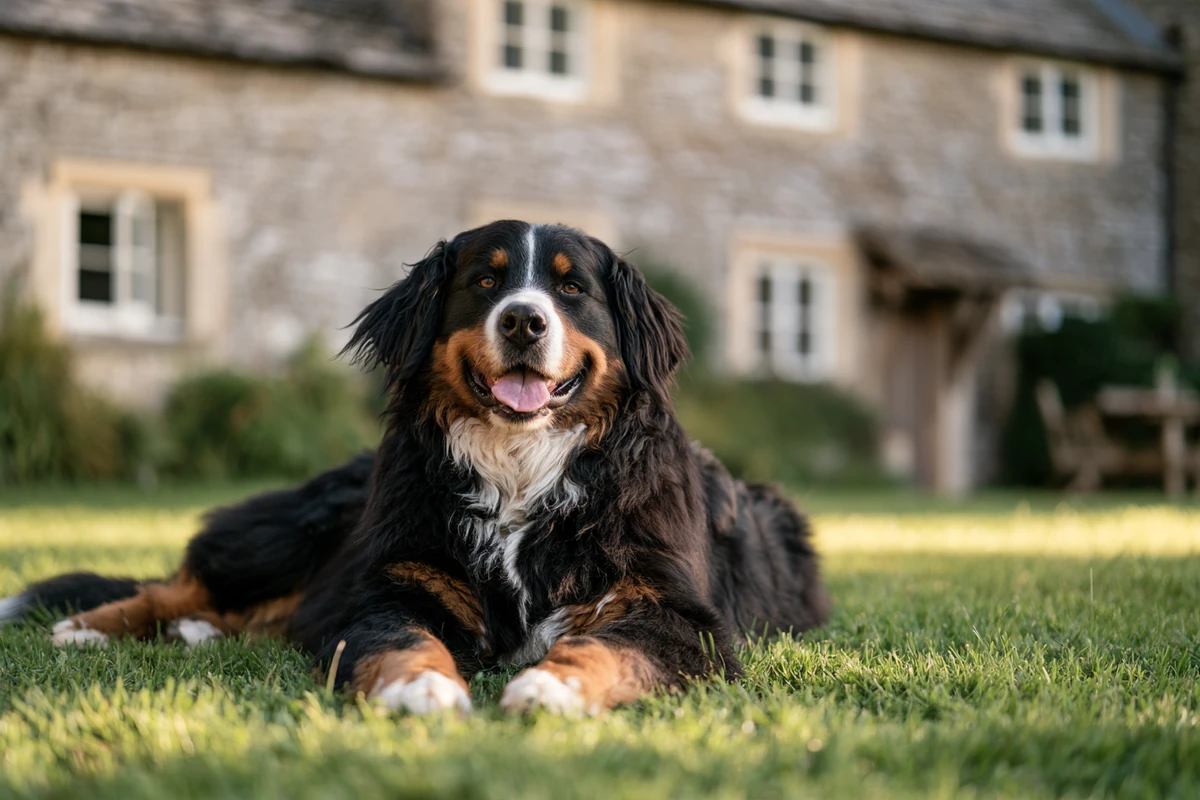
The standard describes a soft, silky coat with a bright natural sheen, long and slightly wavy but not curly in an adult. The colour is jet black with rich reddish-brown on the cheeks, above the eyes, on all four legs and on the chest, together with a white blaze on the head and a white cross on the chest. The RKC recommends grooming more than once a week, and the breed sheds.
Exercise
The RKC suggests up to an hour of exercise a day for adults; the breed club's figure is one to five miles daily. Puppies grow fast and tire quickly, so the club advises plenty of rest and care not to strain young joints.
Temperament and suitability
The standard calls for a self-confident, good-natured, friendly and fearless dog and treats aggression as unacceptable. The Bernese Mountain Dog Club of Great Britain describes loyal family dogs that, once mature, should be affectionate and patient with children, and notes that they do not make good kennel dogs because they prefer to be with their owners. The club also warns that a large, strong dog without proper training can become a handful. The RKC gives a lifespan of under 10 years; the health section explains why.
Bernese Mountain Dog health tests
Short life expectancy is the breed's main health problem. The Bernese Mountain Dog Club of Great Britain reports an average UK age at death of under eight years, with cancer behind around two-thirds of deaths. One cancer, histiocytic sarcoma, accounts for about a quarter of deaths, most often in middle age between five and seven. The club also highlights hip and elbow dysplasia, degenerative myelopathy (DM), which it links to older dogs losing the use of their back legs, and gastric torsion (bloat), an emergency that can be fatal within hours if untreated.
The RKC recommends hip and elbow scoring before breeding. It does not offer a breed-specific DNA testing package, though individual DNA tests are available. The breed club's Code of Ethics asks for all breeding stock to be hip and elbow x-rayed, for DM testing so that no mating can produce affected puppies, for testing through the Antagene (University of Rennes) histiocytic sarcoma scheme, and for a litter COI no higher than twice the breed average. The club's health work runs through its Bernese Health Initiative, launched in late 2020.
- BVA/KC Hip Dysplasia Scheme (RKC recommended; dogs must be at least one year old)
- BVA/KC Elbow Dysplasia Scheme (RKC recommended; dogs must be at least one year old; the BVA advises breeding only from grade 0)
- Degenerative myelopathy (DM) DNA test (breed club Code of Ethics)
- Antagene histiocytic sarcoma test (breed club Code of Ethics)
- Litter COI at or below the breed average (RKC general advice); no more than twice the average (breed club)
- Breed Watch: Category 1 (no breed-specific points of concern listed)
Choosing a Bernese Mountain Dog breeder
A responsible Bernese breeder will show you BVA/KC hip scores and elbow grades for both parents; the breed club tells buyers that if both parents have not been scored they should ask why and probably walk away. Expect the breeder to explain the parents' DM results, their Antagene histio results and the COI of the litter. Because longevity is the breed's biggest concern, ask how long the grandparents and other relatives lived and what they died of. The Bernese Mountain Dog Club of Great Britain's Code of Ethics says a bitch should not be bred before about two years old, should have her first litter before five and her last before seven, that puppies should not leave before eight weeks and should be microchipped first, and that breeders should be prepared to take back a dog at any point in its life. In England, anyone who breeds three or more litters in 12 months and sells any of the puppies needs a licence from the local council. Read our buyer safety guide before you pay a deposit.
- Can I see the hip and elbow certificates for both parents?
- What are the DM and histio test results for the sire and dam?
- How long did the grandparents and other close relatives live?
- What is the COI of this litter compared with the breed average?
- How should I limit exercise while the puppy is growing?
Bernese Mountain Dog questions
How long do Bernese Mountain Dogs live?
The RKC gives a lifespan of under 10 years. The Bernese Mountain Dog Club of Great Britain reports an average UK age at death of under eight, with cancer, especially histiocytic sarcoma, the leading cause. The club also points out that many owners do have dogs that live a reasonable length of healthy life, which is why buyers should ask about longevity in a breeder's lines.
How big does a Bernese Mountain Dog get?
The RKC breed standard gives a height of 64u201370 cm for dogs and 58u201366 cm for bitches, with no set weight. The breed club says Bernese reach full height at around 12 to 15 months and can take another two or three years to mature fully.
What health tests should Bernese parents have?
The RKC recommends hip and elbow scoring under the BVA/KC schemes. The Bernese Mountain Dog Club of Great Britain's Code of Ethics also asks breeders to DNA test for degenerative myelopathy and to use the Antagene histiocytic sarcoma test.
Are Bernese Mountain Dogs good with children?
The breed standard calls for a good-natured, friendly temperament, and the breed club says mature Bernese should be affectionate and patient with children and are happiest living with their family. They are large, strong dogs, so training and supervision around young children still matter.
More for Bernese Mountain Dog owners and breeders
- Bernese Mountain Dog: breeders
- Bernese Mountain Dog: puppies for sale
- Bernese Mountain Dog: stud dogs
- All Working group breeds
- Carting and draught work
Official sources
- Bernese Mountain Dog breed information - The Royal Kennel Club
- Bernese Mountain Dog breed standard - The Royal Kennel Club
- Inbreeding calculators (COI) - The Royal Kennel Club
- Dog Health Test Results Finder - The Royal Kennel Club
- Breed Watch - The Royal Kennel Club
- About the breed - Bernese Mountain Dog Club of Great Britain
- Origins of the breed - Bernese Mountain Dog Club of Great Britain
- Health and welfare - Bernese Mountain Dog Club of Great Britain
- Code of Ethics - Bernese Mountain Dog Club of Great Britain
- Hip Dysplasia Scheme - British Veterinary Association
- Elbow Dysplasia Scheme - British Veterinary Association
- Dog breeding licence (England) - GOV.UK