
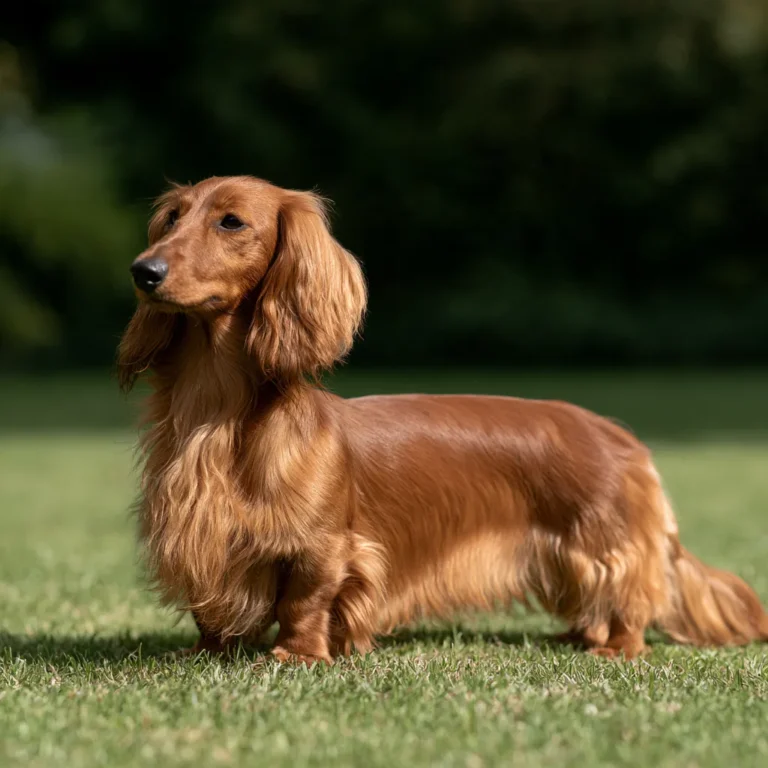
No Long Haired Dachshund puppies are listed right now
Breeders add puppies when they have a litter. One breeder lists the Long Haired Dachshund. Ask them about their next litter.
Long Haired Dachshund breeders
- Cocker Spaniel · French Bulldog · German Shepherd Dog +3Specialities: not listed yetLicensed breeder5-star licence
Archfairy
Chesterfield, Derbyshire

Do you breed the Long Haired Dachshund? Add a litter free.
Buying a Long Haired Dachshund puppy
Searching for Long Haired Dachshund puppies for sale? First check that the litter is standard size: in the UK the standard and miniature Long Haired Dachshunds are separate breeds, puppies cannot be moved between the two sizes at registration, and adults of this breed have an ideal weight of 9–12 kg. Ask for both parents' IVDD grades from the RKC scheme and their eye examination results, and confirm the parents' colours, since puppies from two dapple parents cannot be registered with the RKC. Budget for brushing the soft, feathered coat several times a week and for up to an hour of daily exercise, in line with RKC guidance. Meet the puppies with their mother, check the microchip details and never pay a deposit before viewing. Compare Long Haired Dachshund breeders and read our buyer safety guide.
Health tests to ask about
For the Long Haired Dachshund the RKC lists two good-practice steps before breeding: prioritising genetic diversity, and spine screening under the RKC IVDD Scheme for Dachshunds. Eye testing under the BVA/KC/ISDS Eye Scheme is listed as best practice. The RKC has no DNA test bundle aimed at this breed.
Intervertebral disc disease (IVDD) is the main concern. Dachshund Health UK estimates that around one in four UK Dachshunds may be affected at some point. The RKC reports that in the 2018 DachsLife survey owners reported IVDD in 9.4% of Long Haired Dachshunds over three years old, against 21.1% across all varieties. The scheme uses a single set of X-rays taken between 24 and 48 months of age and grades the spine from 0 (no calcified discs) to 3 (five or more). Grades are published on the RKC Health Test Results Finder, and the RKC's breeding table rates pairings green, amber or red. The RKC stresses that screening lowers the risk but cannot rule IVDD out.
In Breed Watch Category 2, judges look for eye irritation (redness, discharge or tear staining), too little ground clearance, and poor hind conformation or movement. Dachshund Health UK recommends a clinical eye examination before breeding and again after eight years of age.
- Genetic diversity: predicted COI checked with the RKC inbreeding coefficient calculator (RKC good practice)
- RKC IVDD Scheme for Dachshunds: X-ray grade 0–3, taken once between 24 and 48 months (RKC good practice)
- BVA/KC/ISDS Eye Scheme (RKC best practice)
- No RKC registration for puppies from dapple-to-dapple matings made on or after 1 January 2010
- Breed Watch: Category 2
More for Long Haired Dachshund owners and breeders
- Long Haired Dachshund: breeders
- Long Haired Dachshund: puppies for sale
- Long Haired Dachshund: stud dogs
- All Hound group breeds
Official sources
- Dachshund (Long Haired) breed information - The Royal Kennel Club
- Dachshund (Long Haired) breed standard - The Royal Kennel Club
- Breed Watch: Dachshund (Long Haired) Category 2 - The Royal Kennel Club
- IVDD Scheme for Dachshunds - The Royal Kennel Club
- Eye screening scheme - The Royal Kennel Club
- Genetic diversity: managing and maintaining - The Royal Kennel Club
- Inbreeding coefficient calculator - The Royal Kennel Club
- Health Test Results Finder - The Royal Kennel Club
- BVA/KC/ISDS Eye Scheme - British Veterinary Association
- Dachshund Health UK
- Health testing and screening - Dachshund Health UK
- IVDD - Dachshund Health UK
- Eye disease - Dachshund Health UK
- Screening for IVDD - Dachshund IVDD (Dachshund Health UK)
- Exercise and IVDD - Dachshund IVDD (Dachshund Health UK)
- Dog breeding licence (England) - GOV.UK
- Get your dog or cat microchipped - GOV.UK