
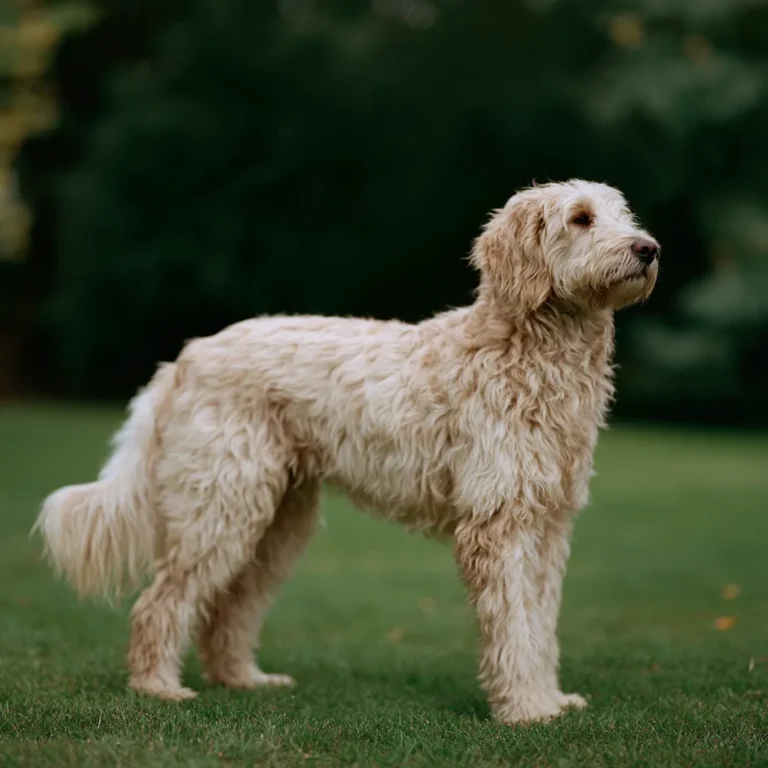
No Goldendoodle stud dogs are listed right now
4 breeders list the Goldendoodle. Ask them if they have a stud dog.
Goldendoodle breeders
- Goldendoodle · LabradoodleSpecialities: not listed yet5-star licence (declared)Mixed breeder
Kingscote Doodles
Torquay, Devon - Goldendoodle · Miniature PoodleSpecialities: not listed yet5-star licence (declared)Mixed breeder
My Posh Pup
Lincoln, Lincolnshire - GoldendoodleSpecialities: not listed yetLicensed breeder1-star licenceMixed breeder
Honey’s Goldendoodledoodles
Ilkeston, Derbyshire - Goldendoodle · LabradoodleSpecialities: not listed yetLicensed breeder5-star licenceMixed breeder
Kelsey House Australian Labradoodles & GoldenDoodles
Burstwick, East Riding of Yorkshire

Do you breed the Goldendoodle? Add a stud dog free.
Using a Goldendoodle stud dog
A Goldendoodle stud dog may be a Goldendoodle used for a second-generation litter, or a pedigree Golden Retriever or Poodle used for a first cross or backcross. Either way, ask for his full health record: a BVA/KC hip score, elbow grade and eye certificate, with gonioscopy where he has Golden Retriever ancestry, plus the relevant DNA results for GR_PRA1, GR_PRA2, ICT-A, prcd-PRA, PRA (rcd4) and vWD1. A pedigree stud should be RKC registered, and his own inbreeding coefficient can be checked with the RKC's inbreeding calculator. A crossbred stud can go on the Activity Register, so his results can be looked up on the Health Test Results Finder. The RKC says pedigree data are not available for crossbreeds, so for Goldendoodle-to-Goldendoodle matings keep your own records and avoid pairing related dogs. Compare the stud's size with the bitch's, as the RKC warns a much larger sire can cause mating and whelping problems.
Health tests for a Goldendoodle stud
A Goldendoodle can inherit conditions from either parent breed. The RKC advises anyone breeding a crossbreed to carry out the recommended tests for both breeds, because complex conditions such as hip and elbow dysplasia involve the same faulty genes across many breeds. The BVA lists the Goldendoodle among the dogs most commonly affected by both, and its screening schemes take crossbreeds as well as pedigrees.
For the Golden Retriever parent, the RKC's Good Practice list is a DNA test for GR_PRA2 plus hip, elbow and eye screening, the eye examination including gonioscopy, which checks the eye's drainage angle for pectinate ligament abnormality linked to glaucoma. Best Practice adds DNA tests for GR_PRA1 and ichthyosis. For the Standard Poodle, the RKC's Best Practice list is DNA tests for two forms of progressive retinal atrophy and von Willebrand disease type 1, with eye and hip screening; the Standard Poodle Club also requires members to test for sebaceous adenitis before breeding. The RKC describes all these DNA-tested conditions as autosomal recessive: a puppy is affected only if both parents pass on a faulty copy.
In Breed Watch the Golden Retriever is in Category 2, with excess weight as the point of concern, and the Standard Poodle is in Category 1. The Goldendoodle itself has no category.
- Golden Retriever, Good Practice: DNA test for progressive retinal atrophy (GR_PRA2)
- Golden Retriever, Good Practice: BVA/KC Hip Dysplasia Scheme and BVA/KC Elbow Dysplasia Scheme
- Golden Retriever, Good Practice: BVA/KC/ISDS Eye Scheme, including gonioscopy for PLA
- Golden Retriever, Best Practice: DNA tests for ichthyosis (ICT-A) and progressive retinal atrophy (GR_PRA1)
- Standard Poodle, Best Practice: DNA tests for progressive retinal atrophy PRA (rcd4), progressive retinal atrophy (prcd-PRA) and von Willebrand disease (vWD1)
- Standard Poodle, Best Practice: BVA/KC/ISDS Eye Scheme and BVA/KC Hip Dysplasia Scheme
- Standard Poodle Club health scheme (linked from the RKC breed page): sebaceous adenitis, diagnosed by skin biopsy
- Mini Goldendoodles: the RKC's Best Practice list for the Miniature Poodle differs, with DNA tests for osteochondrodysplasia (OC) and progressive retinal atrophy (prcd-PRA) plus the BVA/KC/ISDS Eye Scheme and BVA/KC Hip Dysplasia Scheme
More for Goldendoodle owners and breeders
- Goldendoodle: breeders
- Goldendoodle: puppies for sale
- Goldendoodle: stud dogs
- All Crossbreeds breeds
- Poodle crosses and designer crossbreeds
Official sources
- Retriever (Golden) u2013 Royal Kennel Club breed information
- Retriever (Golden) breed standard u2013 Royal Kennel Club
- Poodle (Standard) u2013 Royal Kennel Club breed information
- Poodle (Standard) breed standard u2013 Royal Kennel Club
- Poodle (Miniature) u2013 Royal Kennel Club breed information
- How to breed a crossbred dog u2013 Royal Kennel Club
- Activity Register u2013 Royal Kennel Club
- Breed Watch: Retriever (Golden), Category 2 u2013 Royal Kennel Club
- Breed Watch Category 1 u2013 Royal Kennel Club
- Gonioscopy u2013 Royal Kennel Club
- DNA test for GR_PRA1 u2013 Royal Kennel Club
- DNA test for GR_PRA2 u2013 Royal Kennel Club
- DNA test for ichthyosis (ICT-A) u2013 Royal Kennel Club
- DNA test for prcd-PRA u2013 Royal Kennel Club
- DNA test for PRA (rcd4) u2013 Royal Kennel Club
- DNA test for von Willebrand disease type 1 u2013 Royal Kennel Club
- Health Test Results Finder u2013 Royal Kennel Club
- Inbreeding coefficient calculators u2013 Royal Kennel Club
- BVA/KC Hip Dysplasia Scheme u2013 British Veterinary Association
- BVA/KC Elbow Dysplasia Scheme u2013 British Veterinary Association
- BVA/KC/ISDS Eye Scheme u2013 British Veterinary Association
- Canine Health Schemes u2013 British Veterinary Association
- The Golden Retriever Club
- Sebaceous adenitis u2013 Standard Poodle Club
- Dog breeding licence (England) u2013 GOV.UK
- Get your dog or cat microchipped u2013 GOV.UK
- Animal Welfare (Licensing of Activities Involving Animals) (England) Regulations 2018, Schedule 6