
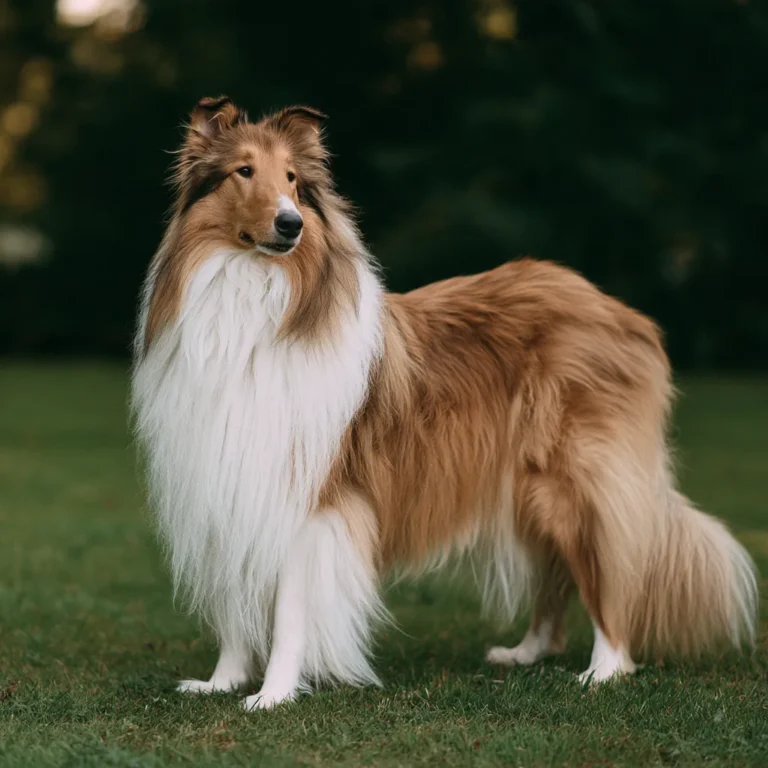
No Rough Collie stud dogs are listed right now
One breeder lists the Rough Collie. Ask them if they have a stud dog.
Rough Collie breeders
- Rough CollieSpecialities: not listed yetLicensed breeder5-star licence
Aldredelie Rough Collies
Bacton, Norfolk

Do you breed the Rough Collie? Add a stud dog free.
Using a Rough Collie stud dog
This page lists Rough Collie stud dogs offered by UK owners. Before booking a mating, ask for the dog's hip score under the BVA/KC Hip Dysplasia Scheme, an eye certificate under the BVA/KC/ISDS Eye Scheme from the past 12 months, and his DNA results for CEA/CH, MDR1, DM and PRA-rcd2, then confirm them on the RKC Health Test Results Finder. The BVA advises breeding only from dogs whose hip scores are under or near the breed median. Avoid pairing two merles, since the RKC will not register the puppies. Confirm the dog's RKC registration and run the pairing through the RKC inbreeding calculator, aiming at or below the breed average; with the breed on the At Watch list, keeping inbreeding low matters. Rough parents can produce Smooth Collie puppies, and the RKC requires such litters to be registered by post. Agree the fee and terms in writing. You can also browse Rough Collie breeders.
Health tests for a Rough Collie stud
The Royal Kennel Club lists eye screening under the BVA/KC/ISDS Eye Scheme, including litter screening, and hip scoring under the BVA/KC Hip Dysplasia Scheme as Good Practice, its recommended minimum before breeding, and adds four DNA tests as Best Practice. The breed is in Breed Watch Category 2; the points of concern for judges are deep-set eyes, incorrect dentition, an excessively narrow jaw, and incorrect hind conformation or poor rear movement. Since 1 January 2013 the RKC has not registered puppies from merle-to-merle matings, because the merle gene carries risks to sight and hearing.
The Collie Association names hip dysplasia, Collie eye anomaly (CEA), progressive retinal atrophy (PRA) and drug sensitivity as the four known inherited problems in UK Rough Collies. It describes CEA as present from birth and non-progressive, says its milder forms do not appear to affect sight, and advises having every puppy in a litter eye examined by a BVA panel ophthalmologist at six to seven weeks. It also explains that a gene mutation makes some collies react badly to ivermectin and a wider group of medicines, and urges owners to check active ingredients; the RKC's MDR1 (multidrug resistance gene 1) DNA test relates to this sensitivity. Results for registered dogs are on the RKC Health Test Results Finder.
- BVA/KC/ISDS Eye Scheme, including litter screening (RKC Good Practice)
- BVA/KC Hip Dysplasia Scheme (RKC Good Practice)
- DNA test: Collie eye anomaly/choroidal hypoplasia (CEA/CH) (RKC Best Practice)
- DNA test: Degenerative myelopathy (DM) (RKC Best Practice)
- DNA test: Multi-drug resistance (MDR1) (RKC Best Practice)
- DNA test: Progressive retinal atrophy (PRA-rcd2) (RKC Best Practice)
- Breed Watch: Category 2
- Breeding restriction: no RKC registration for puppies from merle-to-merle matings born on or after 1 January 2013
- RKC At Watch list (native breed with 300 to 450 registrations a year)
More for Rough Collie owners and breeders
- Rough Collie: breeders
- Rough Collie: puppies for sale
- Rough Collie: stud dogs
- All Pastoral group breeds
Official sources
- Collie (Rough) breed information u2013 The Royal Kennel Club
- Collie (Rough) breed standard u2013 The Royal Kennel Club
- Collie (Rough) Breed Watch Category 2 u2013 The Royal Kennel Club
- Vulnerable native breeds and At Watch list u2013 The Royal Kennel Club
- Collie (Rough) DNA testing u2013 The Royal Kennel Club
- The Collie Association
- The Collie Association u2013 Collie health
- The Collie Association u2013 Collie eye disorders
- The Collie Association u2013 Drug sensitivity
- The Collie Association u2013 Collie care
- Rough Collie Breed Council
- BVA/KC/ISDS Eye Scheme
- BVA/KC Hip Dysplasia Scheme
- Eye screening scheme u2013 The Royal Kennel Club
- Hip dysplasia screening scheme u2013 The Royal Kennel Club
- Health Test Results Finder u2013 The Royal Kennel Club
- Inbreeding calculators u2013 The Royal Kennel Club
- Dog breeding licence (England) u2013 GOV.UK