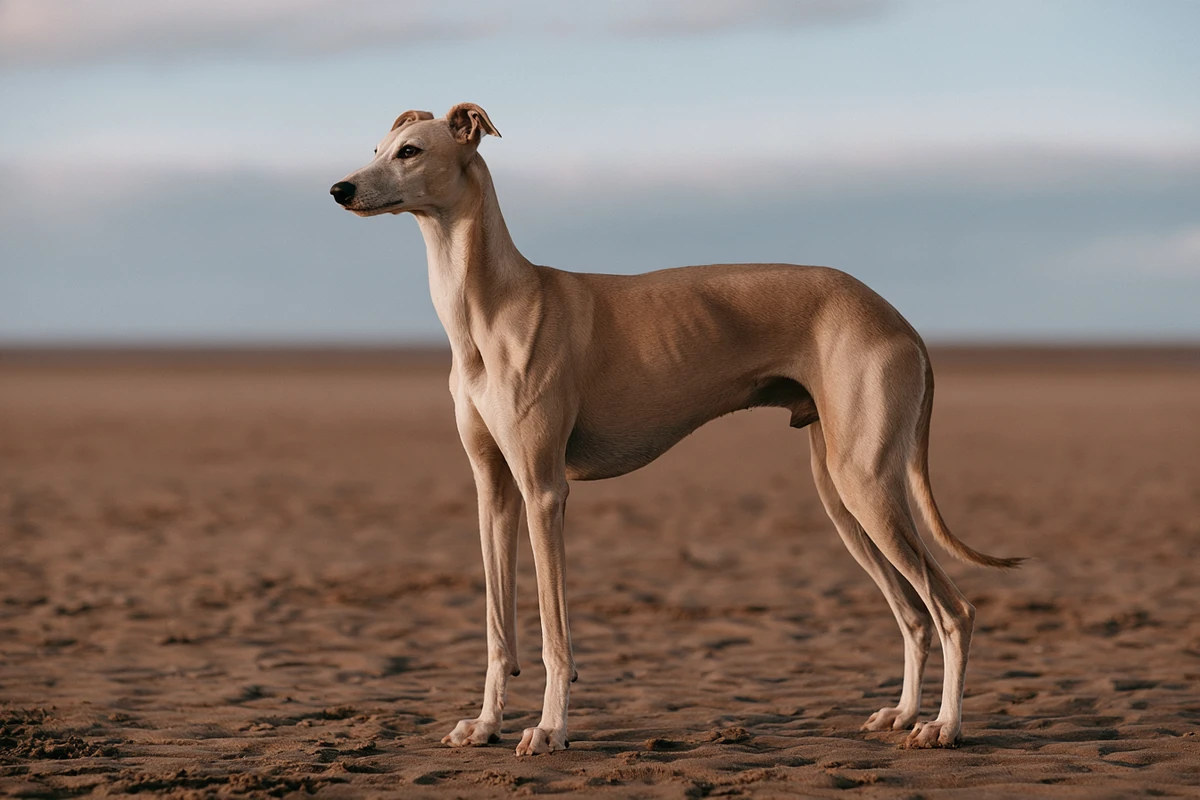

About the Whippet
The Whippet is a sighthound in the Royal Kennel Club's Hound group. The RKC breed page notes that whippet-type dogs were common in the Middle Ages and that genetic studies link the breed to the Greyhound, a hound known to the Romans. The UK Whippet Breed Council explains that undersized greyhounds were bred down, in nineteenth-century northern England, the Midlands and Wales, into a smaller, smooth-coated hound for catching rabbits, rats and hares. Whippet racing became a popular sport, especially in mining and industrial areas, and Kennel Club recognition followed in 1891, according to the council. The RKC says the breed now does well in the show ring and as a family dog, and our whippet racing page covers its sporting side.
Size and build
The breed standard gives heights of 47 to 51 cm (18½ to 20 in) for dogs and 44 to 47 cm (17½ to 18½ in) for bitches, and the RKC puts the breed in its small size category. Built for speed and work, it combines muscle with a graceful outline, free of exaggeration.
Coat and grooming
The coat is fine, short and close. The standard allows any colour or mixture of colours except merle, and the breed council has stated that the merle gene is not present in purebred whippets, so treat any merle whippet advert with suspicion. The RKC suggests grooming once a week, and the breed sheds. The breed council stresses getting a puppy used to nail clipping and mouth handling early, and recommends a warm, waterproof coat for cold or wet weather.
Exercise
The RKC suggests up to an hour a day; the breed council recommends one good run or two shorter ones, plus daily free running in a secure, enclosed area. Whippets hunt by sight, so keep off-lead exercise away from roads and livestock; the council warns that a whippet may never be fully dependable around fast-moving small animals.
Temperament and suitability
The standard describes a gentle, affectionate and even-tempered dog that suits home life and sport alike. The breed council warns that puppies can be demanding for the first 18 months to two years, and advises against leaving an adult alone for more than about four hours. The RKC gives a lifespan of over 12 years, and the council says some reach 16. Related sighthounds include the Greyhound and Italian Greyhound; see also all Hound breed breeders.
Whippet health tests
The Royal Kennel Club's pre-breeding recommendation for the Whippet is to prioritise genetic diversity, producing litters with an inbreeding coefficient at or below the breed average and ideally as low as possible, and it points breeders to the breed club health scheme. The RKC offers no breed-specific DNA testing package. The breed is in Breed Watch Category 1, which the RKC uses for breeds with no visible health concerns linked to conformation.
Heart health is the main focus of the breed clubs. There is no official UK heart scheme for whippets, but a Kennel Club statement published on The Whippet Club's site says all breeding stock should be auscultated (listened to with a stethoscope) before breeding, and the Veterinary Cardiovascular Society advises a Doppler scan for any dog found to have a murmur. The breed council's cardiology update names mitral valve disease and pulmonic stenosis, and says a dog with pulmonic stenosis, however mild, should not be bred from. Autoimmune disease is the council's other main concern, and there is no simple test for it.
A 2026 breed council analysis of RKC-registered whippets put the effective population size at 74, which it places in a genetically vulnerable range, so avoiding overuse of popular sires matters. No test can guarantee a healthy puppy.
Health tests and schemes for the Whippet:
- Prioritising genetic diversity (coefficient of inbreeding at or below the breed average): RKC pre-breeding recommendation
- Breed club health scheme: heart testing by auscultation, carried out by a veterinary cardiologist rather than a general vet
- Doppler echocardiography for any dog found to have a murmur
- RKC DNA testing: no breed-specific package
- Breed Watch: Category 1
Choosing a Whippet breeder
The UK Whippet Breed Council's advice on finding a breeder is that both parents should have been heart tested clear by a certified cardiologist, not just a general vet, within a year of the litter's birth. A careful breeder will show you those certificates, explain the difference between a clear result and a murmur, and tell you the litter's coefficient of inbreeding. Any eye examination should be done by a specialist, the council adds.
Licensed breeders in England may not sell a puppy under eight weeks old, and may only show it to buyers together with its mother, under the 2018 licensing regulations. Anyone breeding three or more litters in a 12-month period and selling any of the puppies needs a council licence, and every puppy must be microchipped by eight weeks. Expect a puppy contract to read in advance and registration papers, with any endorsements explained. Good breeders ask about your home and routine, and offer to take the dog back at any age. The Whippet Club does not list litters online, but its secretary can pass on details of litters from known breeders. Our buyer safety guide explains how to spot scams.
Questions to ask a Whippet breeder:
- Can I see both parents' heart test certificates, and who carried out the tests and when?
- Has either parent had a murmur, and was it followed up with a Doppler scan?
- What is the coefficient of inbreeding for this mating, and how does it compare with the breed average?
- Will the puppy be RKC registered, and are there any endorsements?
- Will you take the dog back at any stage of its life if I cannot keep it?
Whippet questions
Can whippets live with cats and other small pets?
Whippets hunt by sight, and the UK Whippet Breed Council warns that a whippet may never be fully dependable around fast-moving small animals. Careful introductions and supervision are important, and a breeder can tell you how their puppies have been raised.
Do whippets need a coat?
Yes, in cold or wet weather. The coat is fine and short, and the breed council recommends a warm, waterproof coat to keep a whippet comfortable outdoors.
How much exercise does a whippet need?
The breed council says most adults are content with about an hour a day, as one good run or two shorter ones, with free running in a secure, enclosed area. For puppies it suggests roughly five minutes per month of age, twice a day, favouring soft ground over pavements while they grow.
Are there merle whippets?
The Royal Kennel Club breed standard accepts any colour except merle, and the breed council has stated that the merle gene is not present in purebred whippets. Be cautious of any advert offering a merle whippet.
More for Whippet owners and breeders
- Whippet: breeders
- Whippet: puppies for sale
- Whippet: stud dogs
- All Hound group breeds
- Boat and narrowboat dogs
- Dock diving
- Dogs for older owners and retirees
- Ferreting, rabbiting and lurcher work
- Flat-friendly and small-space dogs
- Lure coursing for sighthounds
- Whippet racing
Official sources
- Whippet breed information - Royal Kennel Club
- Whippet breed standard - Royal Kennel Club
- Genetic diversity: managing and maintaining - Royal Kennel Club
- Whippet puppies - The Whippet Club
- The Kennel Club statement on Whippet heart health - The Whippet Club
- UK Whippet Breed Council
- Finding the right breeder - UK Whippet Breed Council
- Is a Whippet right for me? - UK Whippet Breed Council
- Breed health - UK Whippet Breed Council
- Whippet cardiology update - UK Whippet Breed Council
- Statement on merle in Whippets - UK Whippet Breed Council
- Whippet heart screening - Veterinary Cardiovascular Society
- Health Test Results Finder - Royal Kennel Club
- Inbreeding coefficient calculator - Royal Kennel Club
- Using your dog as stud - Royal Kennel Club
- Dog breeding licence (England) - GOV.UK