
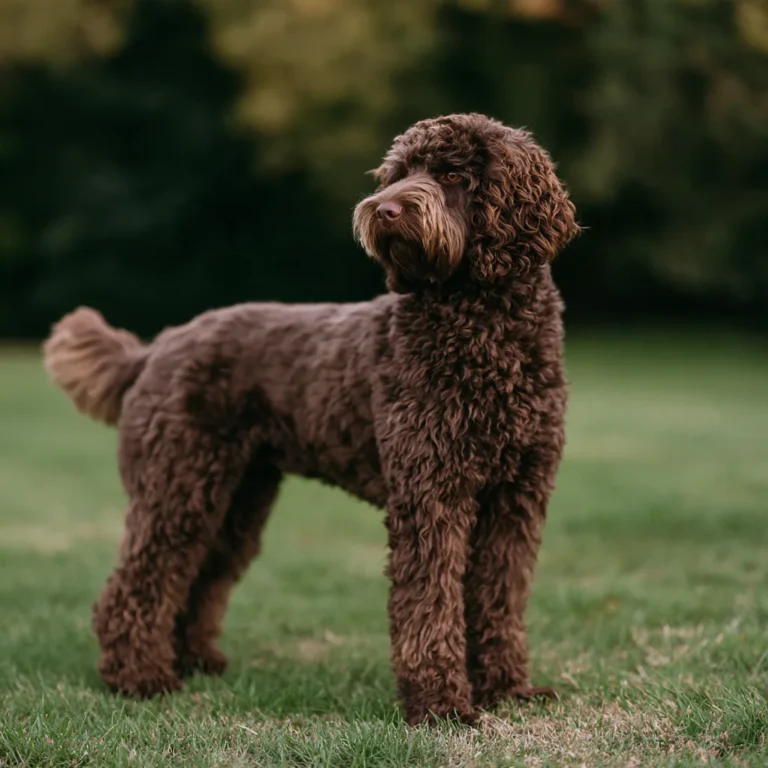
No Sproodle puppies are listed right now
Breeders add puppies when they have a litter. One breeder lists the Sproodle. Ask them about their next litter.
Sproodle breeders
- Cavapoo · Cockapoo · Labradoodle +4Specialities: not listed yetMixed breeder
Furry Friends Of Scotland
Lesmahagow, South Lanarkshire

Do you breed the Sproodle? Add a litter free.
Buying a Sproodle puppy
A Sproodle litter may be a first cross (F1) between an English Springer Spaniel and a Poodle, an F1b litter where a first-cross Sproodle is mated back to one of the parent breeds, or an F2 litter from two first-cross Sproodles. Because the parent breeds differ in size and coat, puppies may differ too, so meet the mother and ask about the father. Plan for an active dog that needs regular grooming, as the RKC puts the Springer's daily exercise needs at over two hours. Before paying a deposit, ask for the Springer parent's hip, elbow and eye results (including gonioscopy) and DNA tests, and the Poodle parent's prcd-PRA and OC results with eye and hip screening. Puppies must be microchipped and registered on a database by eight weeks old. A Sproodle cannot join the RKC Breed Register, but it can go on the Activity Register, which opens up licensed events such as agility.
Health tests to ask about
Health checks for a Sproodle come from the tests the RKC lists for the English Springer Spaniel and the Miniature Poodle. The RKC advises anyone breeding a crossbreed to consider running the full set of tests for both breeds, because with complex conditions such as hip and elbow dysplasia the same faulty genes can be involved in different breeds.
For the Springer, the RKC's Good Practice list covers prioritising genetic diversity, hip scoring, elbow grading and an eye examination with gonioscopy, which checks the eye's drainage angle for an abnormality (PLA) linked to glaucoma. Best Practice adds five DNA tests: PRA (cord1), fucosidosis, PFK deficiency, acral mutilation syndrome and DAMS. The RKC lists no Good Practice tests for the Miniature Poodle; its Best Practice list is DNA tests for prcd-PRA and osteochondrodysplasia (OC), plus eye and hip screening.
The RKC describes each of these DNA conditions as recessive, so a puppy is affected only if it receives a faulty copy from each parent. Running the full set on both parents matters most for F1b and F2 litters, where both parents share ancestry from the same breed. The BVA hip and elbow schemes need the dog to be at least a year old, and the BVA Eye Scheme is open to crossbreeds.
- Spaniel (English Springer), Good Practice: Prioritising genetic diversity
- Spaniel (English Springer), Good Practice: Hip testing (for hip dysplasia) using the BVA/KC Hip Dysplasia Scheme
- Spaniel (English Springer), Good Practice: Elbow testing (for elbow dysplasia) using the BVA/KC Elbow Dysplasia Scheme
- Spaniel (English Springer), Good Practice: Eye testing (and gonioscopy for PLA) using the BVA/KC/ISDS Eye Scheme
- Spaniel (English Springer), Best Practice: DNA tests for acral mutilation syndrome (AMS), dyserythropoietic anaemia and myopathy syndrome (DAMS), fucosidosis (fuco), phosphofructokinase deficiency (PFK) and progressive retinal atrophy PRA (cord1)
- Poodle (Miniature), Best Practice: DNA tests for osteochondrodysplasia (OC) and progressive retinal atrophy (prcd-PRA)
- Poodle (Miniature), Best Practice: Eye testing using the BVA/KC/ISDS Eye Scheme
- Poodle (Miniature), Best Practice: Hip testing (for hip dysplasia) using the BVA/KC Hip Dysplasia Scheme
- Breed Watch: Spaniel (English Springer) Category 1; Poodle (Miniature) Category 1
More for Sproodle owners and breeders
Official sources
- Spaniel (English Springer) u2013 Royal Kennel Club breed information
- Poodle (Miniature) u2013 Royal Kennel Club breed information
- Spaniel (English Springer) breed standard u2013 Royal Kennel Club
- Poodle (Miniature) breed standard u2013 Royal Kennel Club
- What is a crossbreed dog? u2013 Royal Kennel Club
- How to breed a crossbred dog u2013 Royal Kennel Club
- Gonioscopy (PLA) eye testing u2013 Royal Kennel Club
- Eye screening scheme u2013 Royal Kennel Club
- DNA test for PRA (cord1) u2013 Royal Kennel Club
- DNA test for fucosidosis u2013 Royal Kennel Club
- DNA test for PFK deficiency u2013 Royal Kennel Club
- DNA test for acral mutilation syndrome u2013 Royal Kennel Club
- DNA test for DAMS u2013 Royal Kennel Club
- DNA test for osteochondrodysplasia (OC) u2013 Royal Kennel Club
- DNA test for prcd-PRA u2013 Royal Kennel Club
- Breed Watch Category 1 u2013 Royal Kennel Club
- Health Test Results Finder u2013 Royal Kennel Club
- Inbreeding calculators u2013 Royal Kennel Club
- Hip Dysplasia Scheme u2013 British Veterinary Association
- Elbow Dysplasia Scheme u2013 British Veterinary Association
- Eye Scheme u2013 British Veterinary Association
- Miniature Poodle health u2013 The Poodle Council
- Dog breeding licence (England) u2013 GOV.UK
- Get your dog or cat microchipped u2013 GOV.UK