
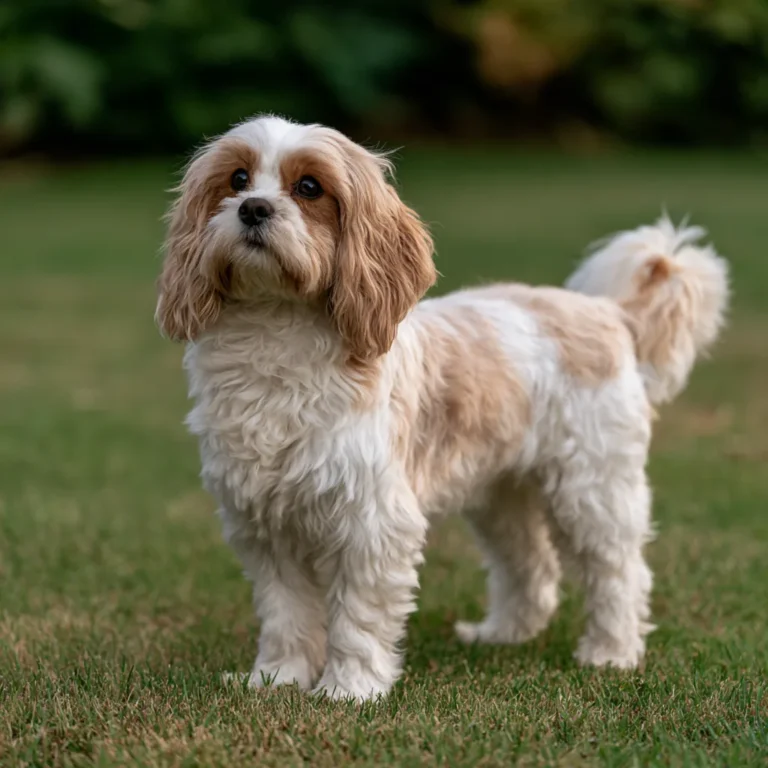
No Cavachon stud dogs are listed right now
One breeder lists the Cavachon. Ask them if they have a stud dog.
Cavachon breeders
- Cavachon · Cavapoo · Cavapoochon +5Specialities: Companion and family dogsMixed breeder
Nutshaw Kennels
Burnley, Lancashire

Do you breed the Cavachon? Add a stud dog free.
Using a Cavachon stud dog
When looking for a Cavachon stud dog, first decide which cross you want: a Cavalier King Charles Spaniel or Bichon Frise stud for a first cross or backcross, or a Cavachon for a second-generation litter. A Cavalier stud should hold a current Kennel Club heart scheme certificate, where green is the lowest-risk grade for breeding, plus CC/DE and EF DNA results and an eye certificate. A Bichon stud should have a BVA/KC/ISDS eye certificate. A Cavachon stud should be DNA tested for CC/DE and EF, since he may carry either condition, and eye tested; ask too how his heart has been checked. Pedigree studs should be RKC registered, and their own inbreeding coefficient can be checked with the RKC calculator. For Cavachon-to-Cavachon matings the RKC says pedigree data are not available, so breeders must keep their own records and avoid pairing related dogs. Agree the fee and terms in writing.
Health tests for a Cavachon stud
A Cavachon can inherit health problems from either side, and the RKC advises anyone breeding a crossbreed to use the tests recommended for both parent breeds. For the Cavalier King Charles Spaniel, the RKC's Good Practice list is DNA tests for curly coat/dry eye and episodic falling, plus heart screening for mitral valve disease (MVD), which the RKC says starts earlier in Cavaliers than in dogs generally. The heart scheme uses approved cardiologists, as most local vets cannot assess dogs for it; dogs can be assessed from 18 months of age, and results are graded green, amber or red for breeding. Best Practice adds an eye examination, which the RKC also lists as Good Practice for the Bichon Frise. The BVA eye scheme accepts crossbreeds as well as pedigrees.
The RKC describes curly coat/dry eye and episodic falling as recessive: a puppy is affected only if it inherits a faulty copy from each parent. When two Cavachons are mated, both should be DNA tested, as either could be a carrier.
The RKC also highlights syringomyelia in Cavaliers, which is diagnosed by MRI; the BVA's CM/SM scheme accepts any dog, crossbreeds included. The Cavalier is in Breed Watch Category 2 and the Bichon in Category 1; the Cavachon has no category.
- Cavalier, Good Practice: DNA test for Curly coat/dry eye (CC/DE)
- Cavalier, Good Practice: DNA test for Episodic falling (EF)
- Cavalier, Good Practice: heart screening for mitral valve disease (MVD) using the Kennel Club heart scheme for Cavalier King Charles Spaniels
- Cavalier, Best Practice: BVA/KC/ISDS Eye Scheme
- Bichon Frise, Good Practice: BVA/KC/ISDS Eye Scheme
- Also available for Cavalier lines, though not on the RKC's Good or Best Practice lists: MRI screening under the BVA Chiari malformation/syringomyelia (CM/SM) scheme
More for Cavachon owners and breeders
Official sources
- Cavalier King Charles Spaniel u2013 Royal Kennel Club breed information
- Cavalier King Charles Spaniel breed standard u2013 Royal Kennel Club
- Bichon Frise u2013 Royal Kennel Club breed information
- Bichon Frise breed standard u2013 Royal Kennel Club
- How to breed a crossbred dog u2013 Royal Kennel Club
- Activity Register u2013 Royal Kennel Club
- Breed Watch: Cavalier King Charles Spaniel, Category 2 u2013 Royal Kennel Club
- Breed Watch Category 1 u2013 Royal Kennel Club
- Heart Scheme for Cavalier King Charles Spaniels u2013 Royal Kennel Club
- DNA test for curly coat/dry eye (CC/DE) u2013 Royal Kennel Club
- DNA test for episodic falling (EF) u2013 Royal Kennel Club
- Cavalier King Charles Spaniel syringomyelia project u2013 Royal Kennel Club
- Health Test Results Finder u2013 Royal Kennel Club
- Inbreeding coefficient calculators u2013 Royal Kennel Club
- BVA/KC/ISDS Eye Scheme u2013 British Veterinary Association
- Chiari malformation/syringomyelia (CM/SM) scheme u2013 British Veterinary Association
- Canine Health Schemes u2013 British Veterinary Association
- The Cavalier King Charles Spaniel Club
- Dog breeding licence (England) u2013 GOV.UK
- Get your dog or cat microchipped u2013 GOV.UK
- Animal Welfare (Licensing of Activities Involving Animals) (England) Regulations 2018, Schedule 6