
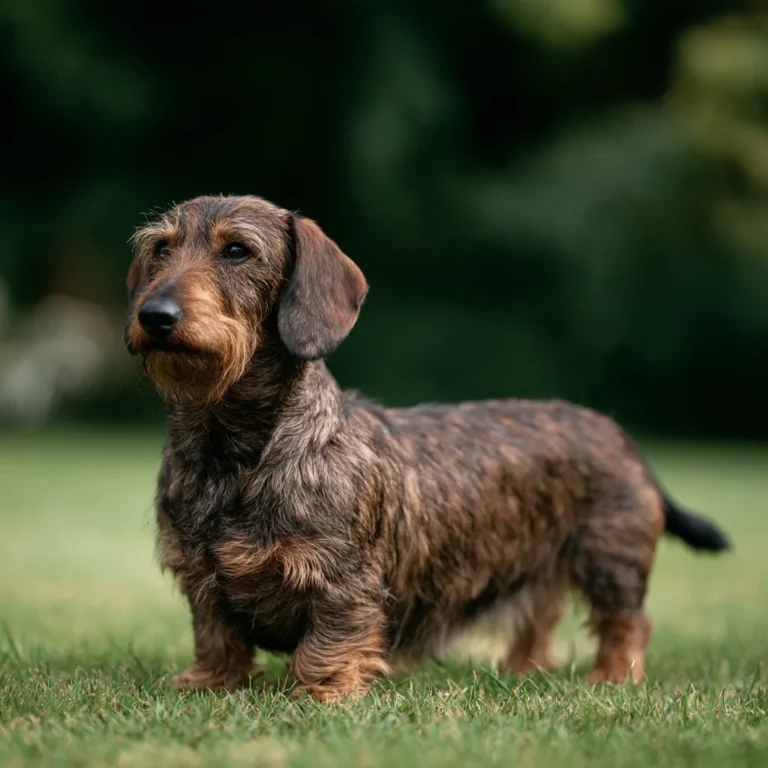
- Wire Haired DachshundSpecialities: not listed yet
Debucher Clipperdown
Berkhamsted, Hertfordshire - Wire Haired DachshundSpecialities: not listed yetLicensed breeder5-star licence
Drakkina-Dachshounds
Chesterfield, Derbyshire

About the Wire Haired Dachshund
The Wire Haired Dachshund is one of six UK Dachshund varieties: standard and miniature sizes, each in smooth, long and wire coats, all sharing one breed standard. The breed comes from Germany, where it is known as the Teckel, or badger dog, and The Royal Kennel Club notes that it is still worked there to track wounded game such as deer and to go to ground after badgers and rabbits. The RKC places it in the Hound group (RKC breed profile). Browse all hound breeders, compare the Smooth Haired, Long Haired and Miniature Wire Haired varieties, or read about deer tracking dogs.
Size and build. The RKC lists the standard Wire as a medium-sized breed, and the breed standard sets an ideal weight of 9 to 12 kg. The body is long in relation to the height but should not be exaggerated, and the chest must clear the ground by at least a quarter of the height at the withers so the dog can move freely. Powerful front legs and a long, strong jaw reflect the breed's original work below ground.
Coat and grooming. The wire coat is short and harsh over a thick undercoat, with a beard, bushy eyebrows and almost smooth hair on the ears. The RKC suggests grooming more than once a week and notes that the breed sheds. Dachshund Health UK recommends a bristle brush and a wide-toothed metal comb, checking the beard and leg hair for tangles. The standard allows red, black and tan, chocolate and tan, wild boar, chocolate wild boar and the dapple pattern; double dapple, blue, Isabella and piebald are all unacceptable.
Exercise. The RKC suggests up to an hour a day and says the breed can live in a small house with a small or medium garden, in town or country. Dachshund Health UK stresses keeping a Dachshund at a healthy weight and varying its daily exercise, warning that a bored dog tends to become noisy and destructive.
Temperament and suitability. The standard describes a faithful, versatile, good-tempered dog that is intelligent and lively, with a boldness that can tip into recklessness. Dachshund Health UK describes them as loyal family dogs but warns that, as hounds, they may ignore recall once on a scent, so training needs patience. The RKC gives a lifespan of over 12 years. See our guide to companion and family dogs.
Wire Haired Dachshund health tests
The Royal Kennel Club's health guidance for the Wire Haired Dachshund puts the spine first. Its Good Practice tier, the minimum it strongly recommends before breeding, is the KC/Dachshund Health UK IVDD scheme. Dogs are X-rayed once, between 24 and 48 months of age, and the number of calcified discs sets a grade from 0 to 3 that stands for life. Dachshund Health UK describes intervertebral disc disease (IVDD) as the most frequent health problem affecting Dachshunds in the UK. In the 2018 DachsLife survey quoted by the RKC, 8.6% of Wire Haired Dachshunds over three had been reported with IVDD, the lowest figure of the six varieties. The RKC's Best Practice tier adds eye examination under the BVA/KC/ISDS Eye Scheme. Dachshund Health UK also recommends NPHP4 PRA (day blindness) screening before breeding for Wires with Scandinavian pedigrees; this is not an RKC listing.
The breed is in Breed Watch Category 2: judges watch for visible eye irritation or discomfort, inadequate ground clearance, and incorrect hind conformation or poor rear movement. The RKC will not register puppies from a mating made on or after 1 January 2010 in which both parents are dapple, because of the risks to sight and hearing. There is no breed-specific RKC DNA package. Recorded results appear on the RKC Health Test Results Finder.
- KC/Dachshund Health UK IVDD Scheme for Dachshunds (RKC Good Practice)
- BVA/KC/ISDS Eye Scheme (RKC Best Practice)
- DNA tests: no breed-specific RKC package listed
- Genetic diversity: check the mating on the RKC inbreeding calculator
- Breed Watch: Category 2 (eye irritation, ground clearance, hind conformation and rear movement)
Choosing a Wire Haired Dachshund breeder
A good Wire Haired Dachshund breeder will have had both parents IVDD graded under the KC/Dachshund Health UK scheme and eye examined, and will show you the certificates; you can confirm the results on the RKC Health Test Results Finder. Dachshund Health UK's breeding guidance urges caution over breeders who advertise 'rare colours': double dapple carries a risk of deafness and blindness, blue and Isabella are associated with skin problems, and none of these is acceptable in the UK. Expect to see the puppies with their mother, see where they are being raised, and answer questions about your home, working hours and exercise plans. The breeder should supply registration papers, a diet sheet, vaccination and worming records, and advice after the sale. In England, anyone who breeds three or more litters in 12 months and sells any of the puppies, or breeds and advertises dogs for sale as a business, needs a council licence and must show the licence number in adverts. Our buyer safety guide explains deposits and scams.
- What IVDD grades do the sire and dam have, and at what age were they X-rayed?
- Do both parents have current eye examination results, and does either have a Scandinavian pedigree that calls for NPHP4 screening?
- Is either parent dapple, and what colour is the other parent?
- What is the coefficient of inbreeding for this mating, and how does it compare with the breed average?
- How do you suggest protecting a Dachshund's back while the puppy grows?
Wire Haired Dachshund questions
How much exercise does a Wire Haired Dachshund need?
The Royal Kennel Club suggests up to an hour a day and says the breed can live in a small house with a small or medium garden. Dachshund Health UK recommends varied daily exercise for mental stimulation and keeping the dog at a healthy weight.
Do Wire Haired Dachshunds get back problems?
Intervertebral disc disease (IVDD) is the main health concern in all Dachshund varieties. The RKC quotes the 2018 DachsLife survey, in which 8.6% of Wire Haired Dachshunds over three had been reported with IVDD, the lowest of the six varieties. Breeders can have their dogs X-rayed and graded under the KC/Dachshund Health UK IVDD scheme.
How do you groom a Wire Haired Dachshund?
The RKC suggests grooming more than once a week, and the breed sheds. Dachshund Health UK recommends a bristle brush and a wide-toothed metal comb, paying attention to the beard and leg hair, along with weekly checks of the eyes, ears and feet and keeping the nails short.
What is the difference between a Wire Haired and a Miniature Wire Haired Dachshund?
They share the same breed standard but differ in size. The standard gives an ideal weight of 9 to 12 kg for the Wire Haired Dachshund, while the RKC says Miniatures should preferably weigh under 5 kg. Dachshund Health UK names Lafora disease, an inherited form of epilepsy, as a priority in Miniature Wires, for which a DNA test is available.
More for Wire Haired Dachshund owners and breeders
- Wire Haired Dachshund: breeders
- Wire Haired Dachshund: puppies for sale
- Wire Haired Dachshund: stud dogs
- All Hound group breeds
Official sources
- Dachshund (Wire Haired) breed information u2013 The Royal Kennel Club
- Dachshund (Wire Haired) breed standard u2013 The Royal Kennel Club
- Dachshund (Wire Haired) Breed Watch Category 2 u2013 The Royal Kennel Club
- KC/Dachshund Health UK IVDD Scheme for Dachshunds u2013 The Royal Kennel Club
- Dachshund Health UK (Dachshund Breed Council health website)
- Dachshund Health UK u2013 Health priorities
- Dachshund Health UK u2013 Health testing and screening
- Dachshund Health UK u2013 Caring for your Dachshund
- Dachshund Health UK u2013 Breeding
- Dachshund Health UK u2013 Advice for buyers
- BVA/KC/ISDS Eye Scheme
- Health Test Results Finder u2013 The Royal Kennel Club
- Inbreeding calculators u2013 The Royal Kennel Club
- Dog breeding licence (England) u2013 GOV.UK