Breed dogs for mountain and moorland search dogs? Advertise here
Buyers and trainers use this page to find breeders whose lines do this work. List your kennel free, tick the industries your dogs work in, and advertise litters and stud dogs from proven working lines.
No breeders are listed here yet, so the first profiles get the page to themselves.
- Free basic profile: your breeder or company name, website, social media, location, breeds and industries.
- Litters and stud dogs advertised in their own sections, never mixed with puppies for sale.
- Premium showcase for your services and prices, previous customers, awards, video, gallery and health certificates, with your phone and email shown to buyers.
- Sponsored articles about your breed or industry, written and published by our team.
- Featured placement at the top of this page, labelled as sponsored.
Is it free to advertise here?
Yes. A breeder profile and your litter and stud dog adverts are free. Premium profiles, featured placement and sponsored articles are optional paid extras; see pricing.
Do I need a licence to advertise puppies?
In England you need a dog breeding licence from your council if you breed three or more litters in 12 months or breed and sell dogs as a business, and Wales, Scotland and Northern Ireland have their own schemes. Licensed breeders show their licence number and issuing council on every advert. Puppies must be at least eight weeks old before they go to new homes.
Is my listing already here?
We add licensed breeders from councils' public registers. Search for your kennel name; if it is listed you can claim it and edit everything.
About mountain and moorland search dogs
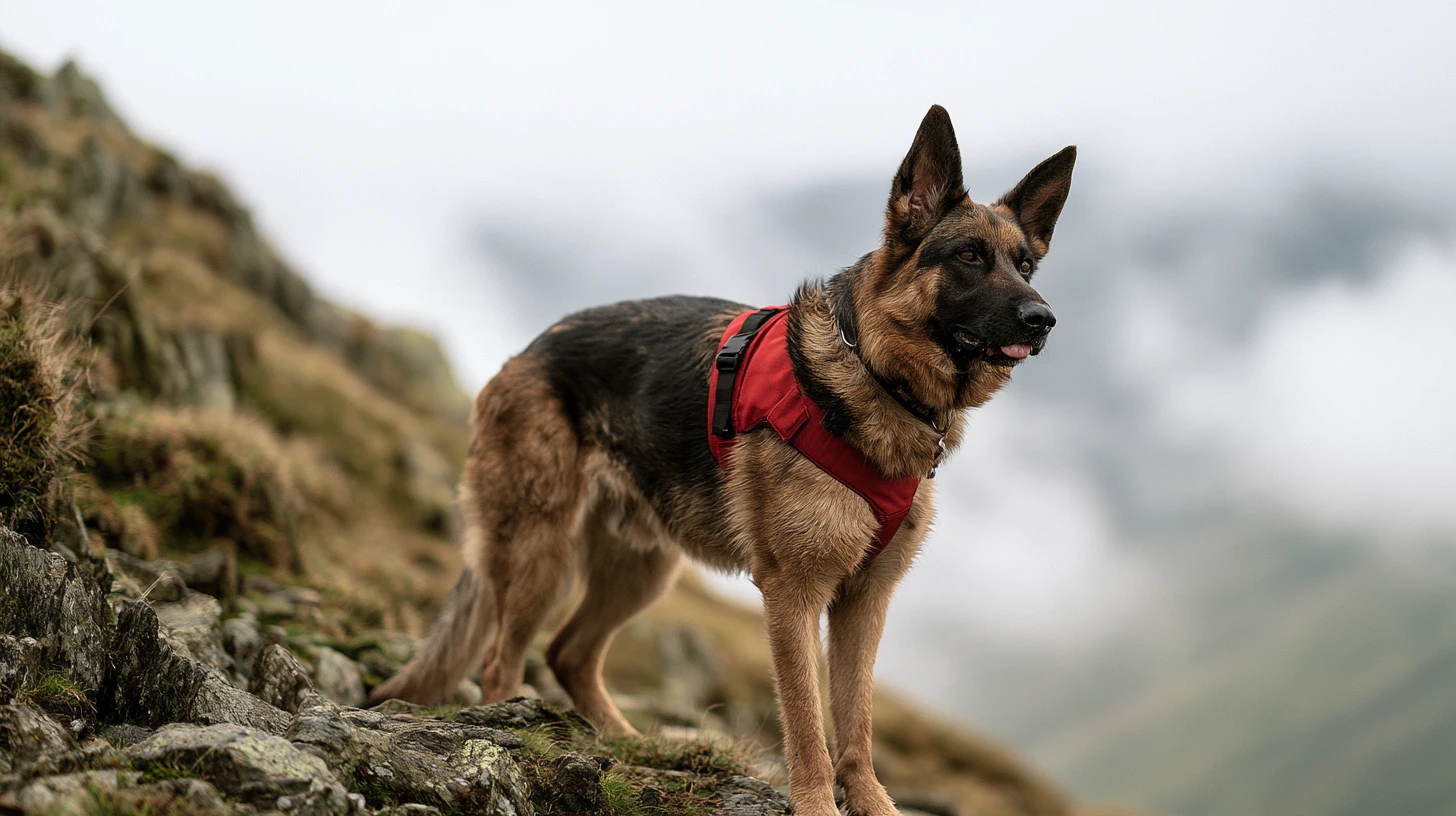
Mountain rescue dogs cover open hill, moor and forest far faster than a line of people on foot. In the UK each one belongs to a volunteer handler who is also a mountain rescue team member. This page explains how search and rescue dogs are trained and assessed in the UK, which search dog breeds tend to succeed, and how to become a search dog handler.
What this work involves
Mountain search dogs are air-scenting dogs. They are not given a scent article. Instead they range across the ground looking for any human scent carried in the air, then indicate the find to their handler. Mountain Rescue Search Dogs England calls this “non-discriminatory air scenting”, and its dogs indicate by returning to their handler and barking. Because the dog works by nose, it can search as effectively at night or in poor visibility as it does by day.
The dogs deploy with mountain rescue teams, at the request of the teams or the police, to find missing walkers, climbers and other vulnerable people on the hills. Training is progressive. Mountain Rescue Search Dogs England starts with a puppy class covering socialisation, obedience and familiarity with livestock, followed by stock tests. The dog then learns the find and the indication, the handler learns to read the ground and how scent moves, and finally the team searches areas blind, without knowing where the hidden “casualty” is. It finishes with an assessment over three days in mountainous terrain, ideally in winter. SARDA Scotland puts the average at about two years to reach full search dog team status.
Who trains and supplies these dogs in the UK
No organisation supplies trained mountain search dogs. Handlers train their own dogs, which are family pets that live at home, through volunteer associations that set standards and run assessments:
- Mountain Rescue Search Dogs England, registered with the Charity Commission as The Search and Rescue Dog Association (England), and Lake District Mountain Rescue Search Dogs.
- SARDA Wales and SARDA South Wales, which with the two English associations make up the four mountain search dog associations serving England and Wales.
- SARDA Scotland, part of Scottish Mountain Rescue, alongside SARDA Southern Scotland, which trains and deploys dogs across Central and Southern Scotland.
- Mountain Rescue England and Wales and Scottish Mountain Rescue, the national bodies for the teams the dogs support.
- The National Search And Rescue Dog Association (NSARDA), a volunteer-run charity and umbrella body whose member associations, including SARDA Wales, SARDA South Wales and SARDA Southern Scotland, are assessed to its standards.
It all began in Glencoe. Hamish MacInnes, then leader of the Glencoe team, had seen avalanche rescue dogs at work in Switzerland, and he set up the first UK training course for mountain rescue dogs in Glencoe in December 1964. The Search and Rescue Dog Association formed the following year and by 1971 had split into Scottish, English and Welsh associations.
Breeds and lines
There is no required breed. The dogs profiled by SARDA Scotland are mostly Border Collies and collie crosses, with Labrador Retrievers and gundog crosses such as a Springer and collie cross. Across NSARDA’s member associations, collies and Labradors make up most of the listed search dogs, and German Shepherd Dogs and spaniels also qualify, including a German Shepherd with SARDA Wales. What matters is drive to hunt and play, stamina for long days in poor weather, a robust but biddable temperament, and complete reliability around sheep and other livestock. Working collie and gundog lines are popular because they tend to combine these traits, but each puppy is judged on its own merits.
What to ask a breeder
- Do any dogs from your lines work in search and rescue, working trials or scent work, and can I speak to their handlers?
- How do the parents behave with livestock, and were the puppies raised around sheep?
- What health results do the parents have? For Border Collies the Royal Kennel Club recommends eye testing with gonioscopy, hip and elbow scoring, and DNA tests including CEA and TNS.
- How do you assess drive, play motivation and confidence in a litter, and will you help me choose a puppy for search work?
- Will you take the dog back or help rehome it if it does not suit search work?
Frequently asked questions
How do I become a search dog handler?
Join your local mountain rescue team first. Mountain Rescue Search Dogs England draws its handlers from full team members with at least a year of operational callout experience. SARDA Scotland asks for at least two years as a full team member, evidence of Scottish winter mountaineering experience and a written reference from your team leader.
Can I buy a trained SARDA dog?
No. Handlers train their own dogs through the associations, and a dog qualifies only by passing assessment with its handler. A breeder can offer a puppy with aptitude, never a qualified search dog.
Where do mountain search dogs live?
At home. Mountain Rescue Search Dogs England says all its dogs are the handlers’ own pets and live with them as members of the family.
Breeders whose dogs work in mountain rescue, or whose collie, gundog or shepherd lines have produced search dogs, are invited to list on the site so prospective handlers can find you.