
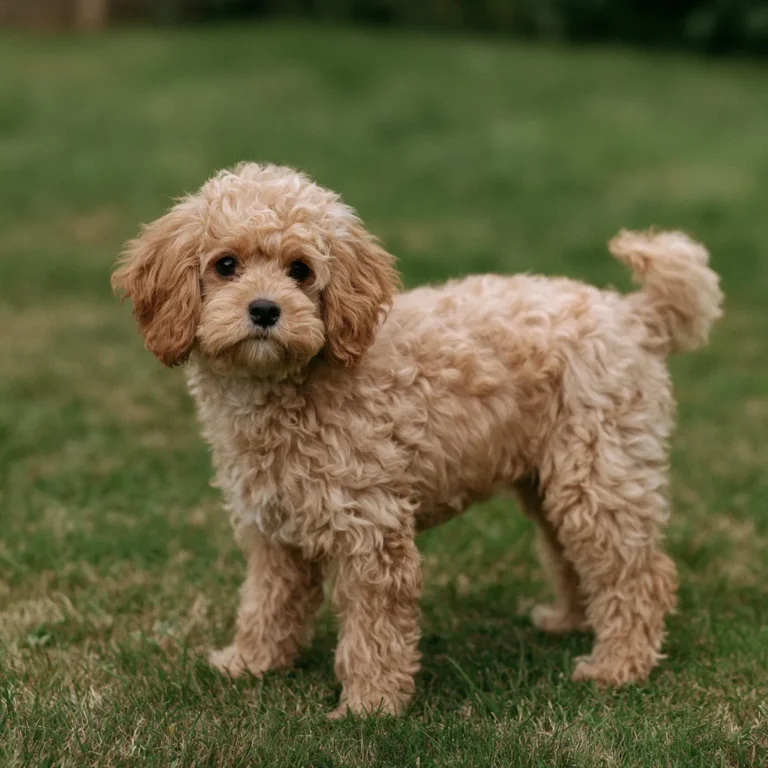
No Cavapoochon puppies are listed right now
Breeders add puppies when they have a litter. 3 breeders list the Cavapoochon. Ask them about their next litter.
Cavapoochon breeders
- Cavapoo · Cavapoochon · PoochonSpecialities: not listed yetMixed breeder
Curly Rascals
St Helens, Merseyside - Cavachon · Cavapoo · Cavapoochon +5Specialities: Companion and family dogsMixed breeder
Nutshaw Kennels
Burnley, Lancashire - Cavapoo · Cavapoochon · CockapooSpecialities: Companion and family dogsMixed breeder
Rosedale Doodles Limited
South Ribble, Lancashire


Do you breed the Cavapoochon? Add a litter free.
Buying a Cavapoochon puppy
Cavapoochon puppies for sale are small companion dogs with three breeds behind them, so no two litters are quite alike. Judge likely adult size and coat from both parents, and ask how earlier litters from the same pairing turned out. A curly coat does not guarantee low shedding, and no puppy can be promised to suit someone with allergies. Before you pay, see the eye and DNA paperwork for both parents and ask about heart checks on the Cavalier side, since the RKC treats mitral valve disease as a significant concern in that breed. Meet the mother with her litter where the puppies were raised. Every puppy must be microchipped and registered on a database by eight weeks old. As a crossbreed the Cavapoochon has no RKC pedigree registration, but it can join the RKC Activity Register for agility, obedience or rally. Budget for regular grooming as well.
Health tests to ask about
Health advice for the Cavapoochon comes from its three parent breeds. For the Cavalier, the RKC's Good Practice list is DNA tests for curly coat/dry eye (CC/DE) and episodic falling (EF) plus heart grading for mitral valve disease under the RKC heart scheme, with eye screening at Best Practice. The RKC also names syringomyelia as one of the main conditions screened for in Cavaliers; it is diagnosed by MRI, and the BVA Chiari malformation/syringomyelia scheme is open to crossbreeds. For the Bichon Frise, eye testing is Good Practice. The Toy Poodle has a DNA test for prcd-PRA at Good Practice, with eye and hip screening at Best Practice, while the Miniature Poodle's list, all at Best Practice, adds a DNA test for osteochondrodysplasia (OC).
The BVA eye and hip schemes accept crossbreeds, and hip X-rays are taken from one year old. The RKC heart scheme starts at 18 months and asks for the dog's RKC registration certificate, so it is used for registered Cavaliers. The Cavalier is in Breed Watch Category 2, with eye irritation, protruding eyes and poor hind movement flagged; the Bichon and both small Poodles are in Category 1. Testing lowers risk but cannot guarantee a healthy puppy.
- Cavalier, Good Practice: DNA tests for curly coat/dry eye (CC/DE) and episodic falling (EF)
- Cavalier, Good Practice: heart screening for mitral valve disease (MVD) under the RKC heart scheme for Cavalier King Charles Spaniels
- Cavalier, Best Practice: BVA/KC/ISDS Eye Scheme; the RKC also points to MRI screening for syringomyelia (BVA CM/SM Scheme)
- Bichon Frise, Good Practice: BVA/KC/ISDS Eye Scheme
- Poodle (Toy): DNA test for progressive retinal atrophy (prcd-PRA) at Good Practice; BVA/KC/ISDS Eye Scheme and BVA/KC Hip Dysplasia Scheme at Best Practice
- Poodle (Miniature), Best Practice: DNA tests for osteochondrodysplasia (OC) and prcd-PRA; BVA/KC/ISDS Eye Scheme and BVA/KC Hip Dysplasia Scheme
- Breed Watch: Cavalier Category 2; Bichon Frise and Poodle (Toy and Miniature) Category 1; the Cavapoochon itself is not covered
More for Cavapoochon owners and breeders
Official sources
- Cavalier King Charles Spaniel u2013 Royal Kennel Club breed information
- Bichon Frise u2013 Royal Kennel Club breed information
- Poodle (Toy) u2013 Royal Kennel Club breed information
- Poodle (Miniature) u2013 Royal Kennel Club breed information
- Heart Scheme for Cavalier King Charles Spaniels u2013 Royal Kennel Club
- Cavalier King Charles Spaniel Breed Watch Category 2 u2013 Royal Kennel Club
- What is a crossbreed dog? u2013 Royal Kennel Club
- Activity Register u2013 Royal Kennel Club
- Health Test Results Finder u2013 Royal Kennel Club
- Eye Scheme u2013 British Veterinary Association
- Hip Dysplasia Scheme u2013 British Veterinary Association
- Chiari Malformation/Syringomyelia Scheme u2013 British Veterinary Association