
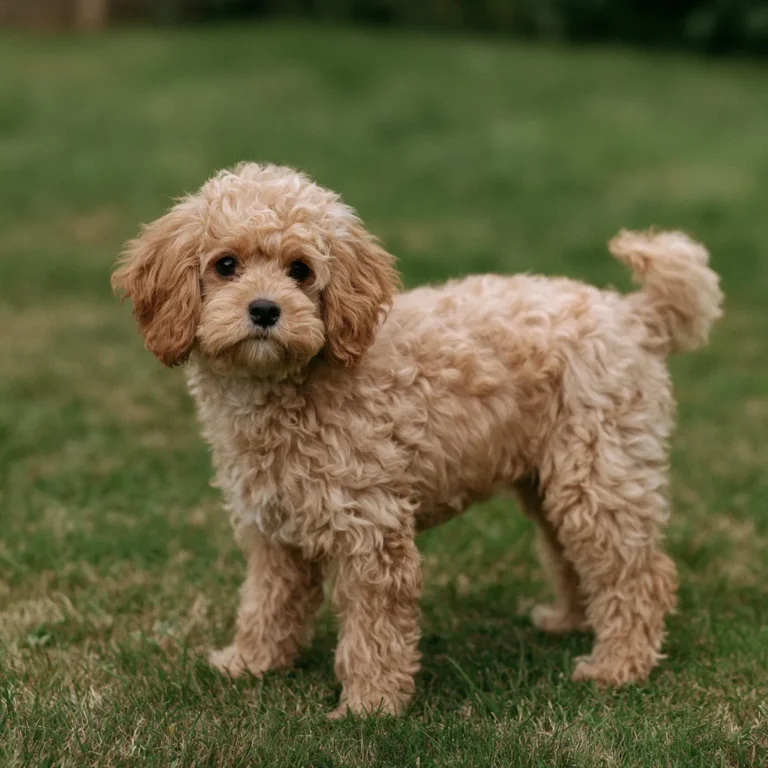
No Cavapoochon stud dogs are listed right now
3 breeders list the Cavapoochon. Ask them if they have a stud dog.
Cavapoochon breeders
- Cavapoo · Cavapoochon · PoochonSpecialities: not listed yetMixed breeder
Curly Rascals
St Helens, Merseyside - Cavachon · Cavapoo · Cavapoochon +5Specialities: Companion and family dogsMixed breeder
Nutshaw Kennels
Burnley, Lancashire - Cavapoo · Cavapoochon · CockapooSpecialities: Companion and family dogsMixed breeder
Rosedale Doodles Limited
South Ribble, Lancashire

Do you breed the Cavapoochon? Add a stud dog free.
Using a Cavapoochon stud dog
A stud dog used to produce Cavapoochons, whether a Cavapoochon, Cavachon, Cavapoo, Bichon Frise or Poodle, should have health paperwork that matches his background. Ask for a current BVA eye certificate, DNA results for CC/DE and EF if he has Cavalier ancestry and for prcd-PRA if he has Poodle ancestry, and a hip score. A pedigree Cavalier stud should have an RKC heart scheme grade; for a crossbreed stud, ask whether his heart has been checked. Pair any carrier only with a clear mate. The RKC's inbreeding coefficient calculator, once known as Mate Select, works from RKC pedigree records and breed averages, so it suits registered pedigree matings rather than crossbreed pairings; compare written pedigrees and avoid mating related dogs. A crossbreed stud on the RKC Activity Register can have his results listed on the Health Test Results Finder. Agree the fee and terms in writing.
Health tests for a Cavapoochon stud
Health advice for the Cavapoochon comes from its three parent breeds. For the Cavalier, the RKC's Good Practice list is DNA tests for curly coat/dry eye (CC/DE) and episodic falling (EF) plus heart grading for mitral valve disease under the RKC heart scheme, with eye screening at Best Practice. The RKC also names syringomyelia as one of the main conditions screened for in Cavaliers; it is diagnosed by MRI, and the BVA Chiari malformation/syringomyelia scheme is open to crossbreeds. For the Bichon Frise, eye testing is Good Practice. The Toy Poodle has a DNA test for prcd-PRA at Good Practice, with eye and hip screening at Best Practice, while the Miniature Poodle's list, all at Best Practice, adds a DNA test for osteochondrodysplasia (OC).
The BVA eye and hip schemes accept crossbreeds, and hip X-rays are taken from one year old. The RKC heart scheme starts at 18 months and asks for the dog's RKC registration certificate, so it is used for registered Cavaliers. The Cavalier is in Breed Watch Category 2, with eye irritation, protruding eyes and poor hind movement flagged; the Bichon and both small Poodles are in Category 1. Testing lowers risk but cannot guarantee a healthy puppy.
- Cavalier, Good Practice: DNA tests for curly coat/dry eye (CC/DE) and episodic falling (EF)
- Cavalier, Good Practice: heart screening for mitral valve disease (MVD) under the RKC heart scheme for Cavalier King Charles Spaniels
- Cavalier, Best Practice: BVA/KC/ISDS Eye Scheme; the RKC also points to MRI screening for syringomyelia (BVA CM/SM Scheme)
- Bichon Frise, Good Practice: BVA/KC/ISDS Eye Scheme
- Poodle (Toy): DNA test for progressive retinal atrophy (prcd-PRA) at Good Practice; BVA/KC/ISDS Eye Scheme and BVA/KC Hip Dysplasia Scheme at Best Practice
- Poodle (Miniature), Best Practice: DNA tests for osteochondrodysplasia (OC) and prcd-PRA; BVA/KC/ISDS Eye Scheme and BVA/KC Hip Dysplasia Scheme
- Breed Watch: Cavalier Category 2; Bichon Frise and Poodle (Toy and Miniature) Category 1; the Cavapoochon itself is not covered
More for Cavapoochon owners and breeders
Official sources
- Cavalier King Charles Spaniel u2013 Royal Kennel Club breed information
- Bichon Frise u2013 Royal Kennel Club breed information
- Poodle (Toy) u2013 Royal Kennel Club breed information
- Poodle (Miniature) u2013 Royal Kennel Club breed information
- Heart Scheme for Cavalier King Charles Spaniels u2013 Royal Kennel Club
- Cavalier King Charles Spaniel Breed Watch Category 2 u2013 Royal Kennel Club
- What is a crossbreed dog? u2013 Royal Kennel Club
- Activity Register u2013 Royal Kennel Club
- Health Test Results Finder u2013 Royal Kennel Club
- Eye Scheme u2013 British Veterinary Association
- Hip Dysplasia Scheme u2013 British Veterinary Association
- Chiari Malformation/Syringomyelia Scheme u2013 British Veterinary Association