
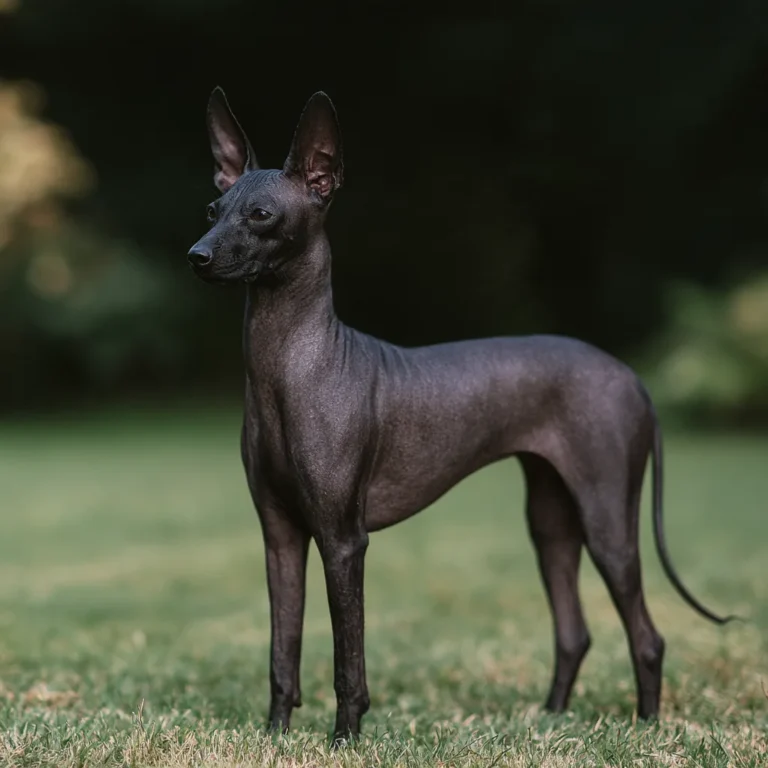
Using a Miniature Xoloitzcuintle (Mexican Hairless) stud dog
Choosing a Miniature Xoloitzcuintle stud means weighing health, temperament and genetic diversity together. The RKC's Best Practice for this size is a BVA/KC hip score and a BVA/KC/ISDS eye examination, so any stud should have both, with results you can confirm on the RKC Health Test Results Finder. He should be RKC registered, and his owner should be willing to run the planned mating through the RKC inbreeding coefficient calculator, long known to breeders as Mate Select; the RKC advises aiming at or below the breed average. In a population this small, a stud unrelated to your bitch's lines is worth seeking out. Look for a cheerful, alert dog that is never aggressive, as the standard asks. Agree the stud fee, any repeat-mating terms and litter registration in writing beforehand. The Miniature remains on the Imported Breed Register after the Standard's move in 2027.
Health tests for a Miniature Xoloitzcuintle (Mexican Hairless) stud
The Miniature is in Breed Watch Category 1: the RKC has not flagged any breed-specific points of concern for show judges beyond those the standard already covers. Breed Watch looks at visible conformation, so it is not a statement that the breed is free of inherited disease.
For breeding dogs, the RKC's Good Practice level is prioritising genetic diversity, and its Best Practice level adds two screening schemes, hips and eyes. Unlike the Intermediate, the Miniature does not have elbow screening on its RKC list. Hip X-rays require the dog to be at least 12 months old and microchipped; the BVA scores each hip and adds the two together for a total between 0 and 106, where lower means less sign of dysplasia. Eye examinations are carried out by BVA-appointed ophthalmologists, and results for RKC-registered dogs appear on the Health Test Results Finder. There is no breed-specific RKC DNA package for the Miniature at present.
Some dental differences are expected in hairless dogs: the standard does not penalise a few missing or rotated teeth, and the Xoloitzcuintli Club of America says hairless Xolos often have an incomplete set of teeth.
- Good Practice: Prioritising genetic diversity (RKC inbreeding coefficient calculator)
- Best Practice: Hip testing using the BVA/KC Hip Dysplasia Scheme
- Best Practice: Eye testing using the BVA/KC/ISDS Eye Scheme
- No breed-specific RKC DNA testing package; individual DNA tests available
- Breed Watch: Category 1
More for Miniature Xoloitzcuintle (Mexican Hairless) owners and breeders
- Miniature Xoloitzcuintle (Mexican Hairless): breeders
- Miniature Xoloitzcuintle (Mexican Hairless): puppies for sale
- Miniature Xoloitzcuintle (Mexican Hairless): stud dogs
- All Utility group breeds
Official sources
- Xoloitzcuintle (Mex Hairless) Min (Imp) u2013 Royal Kennel Club breed information
- Xoloitzcuintle (Mex Hairless) Min (Imp) breed standard u2013 Royal Kennel Club
- Imported Breed Register policy u2013 Royal Kennel Club
- Breed Watch Category 1 u2013 Royal Kennel Club
- Health Test Results Finder u2013 Royal Kennel Club
- Inbreeding coefficient calculators u2013 Royal Kennel Club
- BVA/KC Hip Dysplasia Scheme u2013 British Veterinary Association
- BVA/KC/ISDS Eye Scheme u2013 British Veterinary Association
- Xoloitzcuintle Club UK
- Three breeds to transfer to the Breed Register u2013 Xoloitzcuintle Club UK
- Dog breeding licence (England) u2013 GOV.UK
- Get your dog microchipped u2013 GOV.UK