
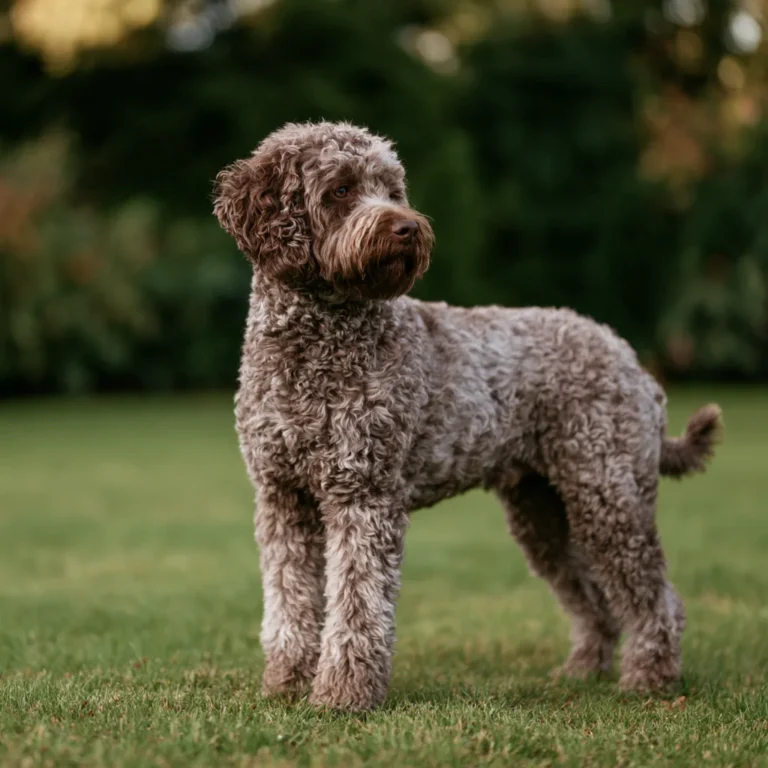
About the Lagotto Romagnolo
The Lagotto Romagnolo is a small to medium curly-coated gundog from the Romagna area of northern Italy, and sits in The Royal Kennel Club's (RKC) Gundog group. The RKC explains that Lagotto is a dialect word for a curly-coated duck retriever, and that the breed first worked in the marshes of Romagna. After the marshes were drained in the early 20th century, its nose was turned to truffles. The Lagotto Romagnolo Club of Great Britain (LRCGB) says it is the only pure breed recognised internationally as a specialist truffle searcher. The club's UK history records that the first two dogs arrived in the UK from Italy in early 1997, Kennel Club recognition followed in 2000 and breed classes began in 2015. The RKC raised its Challenge Certificate allocation from three to seven sets for 2026.
Size and build. The breed standard describes a square, sturdy dog of rustic appearance. Dogs stand 43 to 48 cm and weigh 13 to 16 kg; bitches stand 41 to 46 cm and weigh 11 to 14 kg.
Coat and grooming. The woolly, waterproof coat forms dense ring-shaped curls and is presented naturally, without styling. Colours include off-white, white with brown or orange markings, roan, brown and orange; black is not allowed. The RKC says the breed does not shed and suggests grooming more than once a week. The LRCGB's maintenance advice is regular combing with a metal comb to catch mats, no slicker brushes (they strip the undercoat), ear hair removal and a clip once or twice a year. The club says the coat can suit families with allergies, but reactions vary; see our guide to low-shedding breeds.
Exercise. The RKC suggests more than two hours of exercise a day, a country home and a large garden, though a small house can suit. The club notes that most Lagottos enjoy water and digging.
Temperament. The standard describes a lively, intelligent and affectionate dog that makes an alert family companion. The club's Right for You? page says Lagottos need training from day one, respond poorly to harsh methods, need human company and may bark at strangers. The RKC gives a lifespan of over 12 years.
See also our pages on truffle dogs, gundog working tests and the Italian Spinone, another Italian gundog. UK breed clubs include the LRCGB, founded in 1996, and the Lagotto Romagnolo Association.
Lagotto Romagnolo health tests
The RKC's health guidance lists two DNA tests as Good Practice, the minimum it strongly recommends before breeding: juvenile epilepsy (JE) and lysosomal storage disease (LSD). Both are autosomal recessive, so pairing a carrier with a dog that is clear avoids puppies affected by that condition. The LRCGB explains that JE causes seizures in young puppies, usually starting at five to nine weeks and settling by eight to 13 weeks, while signs of LSD can appear early in life or not until middle or old age, and include movement problems, seizures, deafness and blindness. The RKC offers both tests in a breed DNA package. As Best Practice it recommends hip scoring under the BVA/KC Hip Dysplasia Scheme, elbow grading under the BVA/KC Elbow Dysplasia Scheme and an eye examination under the BVA/KC/ISDS Eye Scheme. There are no additional breed-specific breeding restrictions. The LRCGB's health pages also cover patellar luxation and cerebellar abiotrophy, and its breed-specific ethics require a clear eye certificate from within the year before a mating and allow only dogs with elbow grade 0 to be bred from. The breed is in Breed Watch Category 1: no breed-specific points of concern have been flagged for show judges.
- DNA test: Juvenile Epilepsy (JE) (RKC Good Practice)
- DNA test: Lysosomal Storage Disease (LSD) (RKC Good Practice)
- BVA/KC Hip Dysplasia Scheme (RKC Best Practice)
- BVA/KC Elbow Dysplasia Scheme (RKC Best Practice)
- BVA/KC/ISDS Eye Scheme (RKC Best Practice)
- Patella screening (listed by the LRCGB, not an RKC requirement)
- Breed Watch: Category 1
Choosing a Lagotto Romagnolo breeder
A careful Lagotto breeder will have DNA tested both parents for JE and LSD, hip scored and elbow graded them, and had their eyes examined, and will be glad for you to check the results on the RKC Health Test Results Finder. The LRCGB's breed-specific ethics ask members not to breed from a bitch before her second season or 18 months of age, or after she turns eight, to limit her to four litters, to microchip every puppy and not to let puppies leave before eight weeks. Members must also take back any dog they bred at any point in its life. The club keeps a breeders list of members who have signed up to its rules, but asks buyers to make their own checks and notes that some breeders prefer not to be listed. Microchipping and registration by eight weeks is also a legal duty, as GOV.UK explains. Expect questions about your working hours, as the club says Lagottos need company. In England, a council breeding licence is needed by anyone running a dog breeding business or breeding three or more litters in 12 months and selling any puppies. Our buyer safety guide explains how to avoid scams.
- What are both parents' JE and LSD DNA results?
- Can I see the parents' hip scores, elbow grades and a current eye certificate?
- What is the coefficient of inbreeding for this litter compared with the breed average?
- How do the parents behave with visitors, and how have the puppies been socialised?
- Will you take the dog back at any age if I cannot keep it?
Lagotto Romagnolo questions
Is the Lagotto Romagnolo hypoallergenic?
No dog can be guaranteed to be allergy-free. The RKC says the Lagotto does not shed, and the Lagotto Romagnolo Club of Great Britain says this can suit families with allergies, but it points out that people can also react to dander or saliva. Spend time with adult Lagottos before committing.
How much grooming does a Lagotto need?
The RKC suggests grooming more than once a week. The breed club advises combing regularly with a metal comb to find mats early, removing excess hair from inside the ears and clipping the coat once or twice a year. Matting is most likely between about 9 and 18 months, while the adult coat comes through.
What health tests should a Lagotto puppy's parents have?
The RKC's Good Practice tests are DNA tests for juvenile epilepsy (JE) and lysosomal storage disease (LSD). It also recommends hip scoring, elbow grading and a BVA/KC/ISDS eye examination as Best Practice. You can check a registered dog's results on the RKC Health Test Results Finder.
Can a Lagotto Romagnolo be trained to find truffles?
Yes. The breed moved from retrieving waterfowl to truffle searching after the Romagna marshes were drained, and the LRCGB describes it as the only pure breed recognised internationally as a specialist truffle searcher. The club also covers truffle training and tests, and activities such as gundog work, agility, rally and scent work.
More for Lagotto Romagnolo owners and breeders
- Lagotto Romagnolo: breeders
- Lagotto Romagnolo: puppies for sale
- Lagotto Romagnolo: stud dogs
- All Gundog group breeds
- Low-shedding and non-moulting coated dogs
- Truffle hunting dogs
Official sources
- Lagotto Romagnolo breed information - The Royal Kennel Club
- Lagotto Romagnolo breed standard - The Royal Kennel Club
- Lagotto Romagnolo breed-specific DNA package - The Royal Kennel Club
- Breed Watch Category 1 - The Royal Kennel Club
- BVA/KC Hip Dysplasia Screening Scheme - The Royal Kennel Club
- BVA/KC Elbow Dysplasia Screening Scheme - The Royal Kennel Club
- BVA/KC/ISDS Eye Screening Scheme - The Royal Kennel Club
- BVA Hip Dysplasia Scheme for dogs
- BVA Elbow Dysplasia Scheme for dogs
- BVA Hereditary Eye Disease Scheme for dogs
- Health Test Results Finder - The Royal Kennel Club
- Inbreeding Coefficient (COI) Lookup - The Royal Kennel Club
- Extended CC allocations for the Lagotto Romagnolo - The Royal Kennel Club
- Lagotto Romagnolo Club of Great Britain
- The breed - Lagotto Romagnolo Club of Great Britain
- History of the Lagotto in the UK - Lagotto Romagnolo Club of Great Britain
- Health - Lagotto Romagnolo Club of Great Britain
- Juvenile epilepsy - Lagotto Romagnolo Club of Great Britain
- Lysosomal storage disease - Lagotto Romagnolo Club of Great Britain
- Breed-specific ethics - Lagotto Romagnolo Club of Great Britain
- Breeders list - Lagotto Romagnolo Club of Great Britain
- Is a Lagotto right for you? - Lagotto Romagnolo Club of Great Britain
- Day-to-day coat maintenance - Lagotto Romagnolo Club of Great Britain
- Lagotto Romagnolo Club of Great Britain - RKC Find a Club
- Lagotto Romagnolo Association - RKC Find a Club
- Get your dog or cat microchipped - GOV.UK
- Dog breeding licence (England) - GOV.UK