
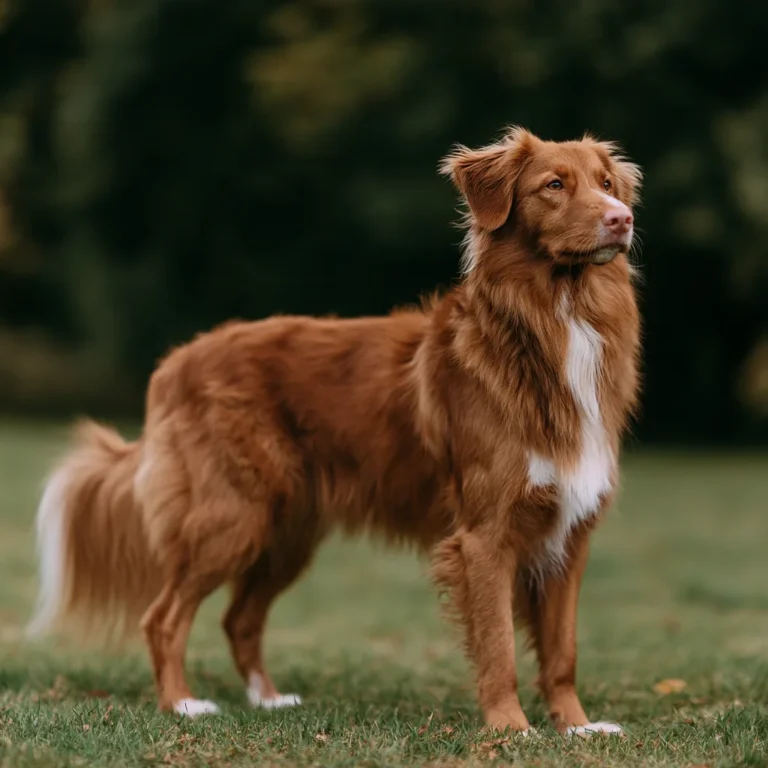
Using a Nova Scotia Duck Tolling Retriever stud dog
The Nova Scotia Duck Tolling Retriever stud dogs listed here are advertised by their owners. Before agreeing a mating, check that the dog is RKC registered without breeding endorsements and ask to see his DM and prcd-PRA DNA results, the two RKC Good Practice tests. To meet the Best Practice standard he also needs CEA/CH, DE and JADD results, a current BVA/KC/ISDS eye certificate, and hip and elbow results. Because the RKC lists genetic diversity as a Good Practice priority for Tollers, run the pairing through its online inbreeding coefficient calculator. The UK breed club advises that a known carrier for a condition should only be mated to a partner tested clear for the same condition. The RKC's guide to finding a suitable mate recommends seeing the dog yourself and setting out the terms in writing, including what happens if no litter results.
Health tests for a Nova Scotia Duck Tolling Retriever stud
The RKC places the Toller in Breed Watch Category 1, so no breed-specific points of concern have been flagged for show judges beyond those the breed standard already covers.
Under the RKC health standard, the Good Practice tests are the minimum a breeder should complete before breeding, and Best Practice means completing both lists below. For this breed the Good Practice list also includes prioritising genetic diversity, which the RKC's inbreeding coefficient calculator can help with. Results for registered dogs are published on the Health Test Results Finder.
The UK breed club's health page describes further conditions seen in Tollers. Autoimmune diseases, among them steroid responsive meningitis arteritis (SRMA) and immune mediated polyarthritis (IMPA), have no DNA test. Hypothyroidism has none either, and the only test linked to Addison's disease covers the juvenile form, so a clear JADD result does not rule the adult condition out. The club advises against breeding from affected dogs, and it reports that mast cell tumours are diagnosed more often in Tollers than in dogs generally. No test result can guarantee a healthy puppy, so ask breeders what they know about these conditions in their lines.
Good Practice
- Prioritising genetic diversity
- DNA test for Degenerative myelopathy (DM)
- DNA test for Progressive retinal atrophy (prcd-PRA)
Best Practice (in addition)
- DNA test for Collie eye anomaly/choroidal hypoplasia (CEA/CH)
- DNA test for Degenerative encephalopathy (DE)
- DNA test for Juvenile Addison's disease (JADD)
- Eye testing using the BVA/KC/ISDS Eye Scheme
- Elbow testing using the BVA/KC Elbow Dysplasia Scheme
- Hip testing using the BVA/KC Hip Dysplasia Scheme
More for Nova Scotia Duck Tolling Retriever owners and breeders
- Nova Scotia Duck Tolling Retriever: breeders
- Nova Scotia Duck Tolling Retriever: puppies for sale
- Nova Scotia Duck Tolling Retriever: stud dogs
- All Gundog group breeds
Official sources
- Retriever (Nova Scotia Duck Tolling) breed information - Royal Kennel Club
- Retriever (Nova Scotia Duck Tolling) breed standard - Royal Kennel Club
- Breed Watch Category 1 - Royal Kennel Club
- The Royal Kennel Club health standard
- Health Test Results Finder - Royal Kennel Club
- Inbreeding coefficient calculator - Royal Kennel Club
- How to find a suitable mate - Royal Kennel Club
- Nova Scotia Duck Tolling Retriever Club of UK
- Toller health - Nova Scotia Duck Tolling Retriever Club of UK
- What to look for when contacting a Toller breeder - Nova Scotia Duck Tolling Retriever Club of UK
- Breeders code of ethics - Nova Scotia Duck Tolling Retriever Club of UK
- Eye Scheme (BVA/KC/ISDS) - BVA Canine Health Schemes
- Hip Dysplasia Scheme (BVA/KC) - BVA Canine Health Schemes
- Elbow Dysplasia Scheme (BVA/KC) - BVA Canine Health Schemes
- Dog breeding licence (England) - GOV.UK