
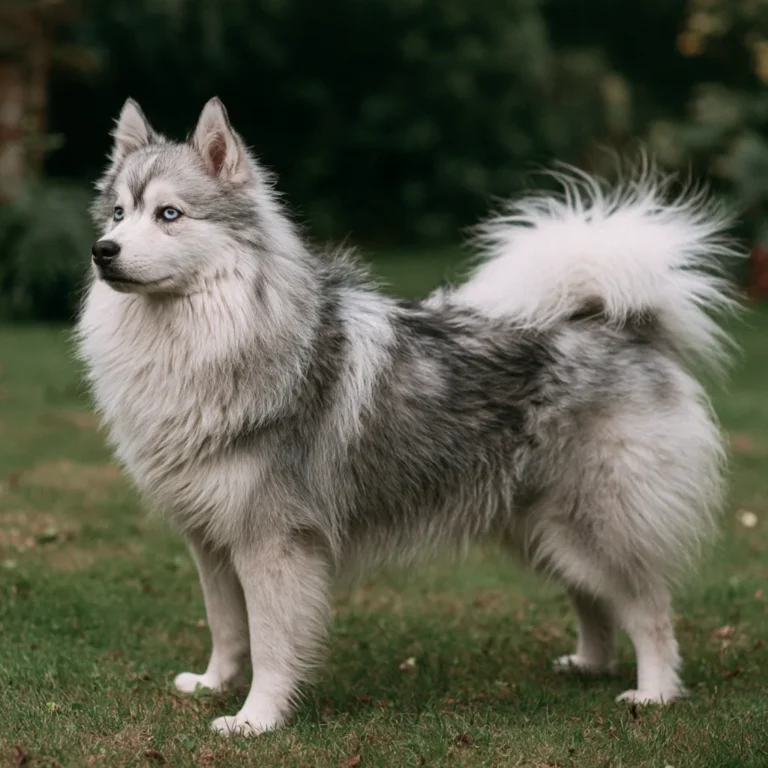
Using a Pomsky stud dog
A Pomsky stud dog may be a Pomeranian, a Siberian Husky or a Pomsky, and the checks depend on which. A pure-bred stud should be RKC registered, with results you can confirm on the Health Test Results Finder: for a Husky, a current eye certificate with a gonioscopy grade and a BVA/RKC hip score; for a Pomeranian, a current eye certificate. The RKC's inbreeding coefficient calculator works from its pedigree records, so it can show how inbred a pure-bred stud is himself, and the RKC advises keeping pedigree litters at or below the breed average. A Pomsky stud cannot be on the RKC Breed Register, so ask for his BVA eye, hip and elbow results and details of his parents. UKPA members must keep a planned mating's inbreeding coefficient below 6.25%. Given the size gap between the parent breeds, discuss the plan with your vet before agreeing terms in writing.
Health tests for a Pomsky stud
As a crossbreed, the Pomsky has no RKC health requirements of its own, so base your checks on each parent breed. For the Siberian Husky, the RKC's Good Practice tests are prioritising genetic diversity and eye testing, including gonioscopy for pectinate ligament abnormality (PLA), a fault in the eye's drainage angle linked to primary glaucoma. Hip scoring is Best Practice for the Husky, and eye testing is Best Practice for the Pomeranian. The BVA says its eye scheme accepts crossbreeds without RKC registration. Since January 2026 gonioscopy results have been graded 1 to 3, and only grade 3 dogs are considered at risk of glaucoma. Hips are X-rayed once a dog is at least a year old and scored from 0 to 106, with lower scores better.
The UKPA requires its breeder members to hip and elbow score breeding dogs, have a standard eye test every year and gonioscopy every three years, carry out DNA testing, and keep a planned litter's inbreeding coefficient below 6.25%. Both parent breeds are in Breed Watch Category 2: judges watch Huskies for being too fat or too thin, and check that Pomeranians over 12 months have a fully closed fontanelle. Merle is unacceptable in the Husky standard and a fault in the UKPA standard. No test result can guarantee a healthy puppy.
- Siberian Husky (Good Practice): prioritising genetic diversity
- Siberian Husky (Good Practice): eye testing (and gonioscopy for PLA) using the BVA/RKC/ISDS Eye Scheme
- Siberian Husky (Best Practice): hip testing using the BVA/RKC Hip Dysplasia Scheme
- Pomeranian (Best Practice): eye testing using the BVA/KC/ISDS Eye Scheme
- UKPA breeder members (club requirement, not an RKC scheme): BVA hip and elbow scoring, yearly standard eye test, gonioscopy every three years, DNA testing, litter inbreeding coefficient below 6.25%
- No breed-specific RKC DNA testing package for either parent breed; individual DNA tests are available
- Breed Watch: Siberian Husky Category 2; Pomeranian Category 2; none for the Pomsky itself
More for Pomsky owners and breeders
Official sources
- Pomeranian u2013 Royal Kennel Club breed information
- Siberian Husky u2013 Royal Kennel Club breed information
- What is a crossbreed dog? u2013 Royal Kennel Club
- United Kingdom Pomsky Association
- Breed Watch: Siberian Husky, Category 2 u2013 Royal Kennel Club
- Breed Watch: Pomeranian, Category 2 u2013 Royal Kennel Club
- BVA/KC/ISDS Eye Screening Scheme u2013 Royal Kennel Club
- PLA (gonioscopy) eye testing u2013 Royal Kennel Club
- BVA/KC Hip Dysplasia Screening Scheme u2013 Royal Kennel Club
- Genetic diversity: managing and maintaining u2013 Royal Kennel Club
- Eye Scheme u2013 British Veterinary Association
- Hip Scheme u2013 British Veterinary Association
- Inbreeding coefficient calculators u2013 Royal Kennel Club
- Health Test Results Finder u2013 Royal Kennel Club
- Dog breeding licence (England) u2013 GOV.UK
- Get your dog microchipped u2013 GOV.UK