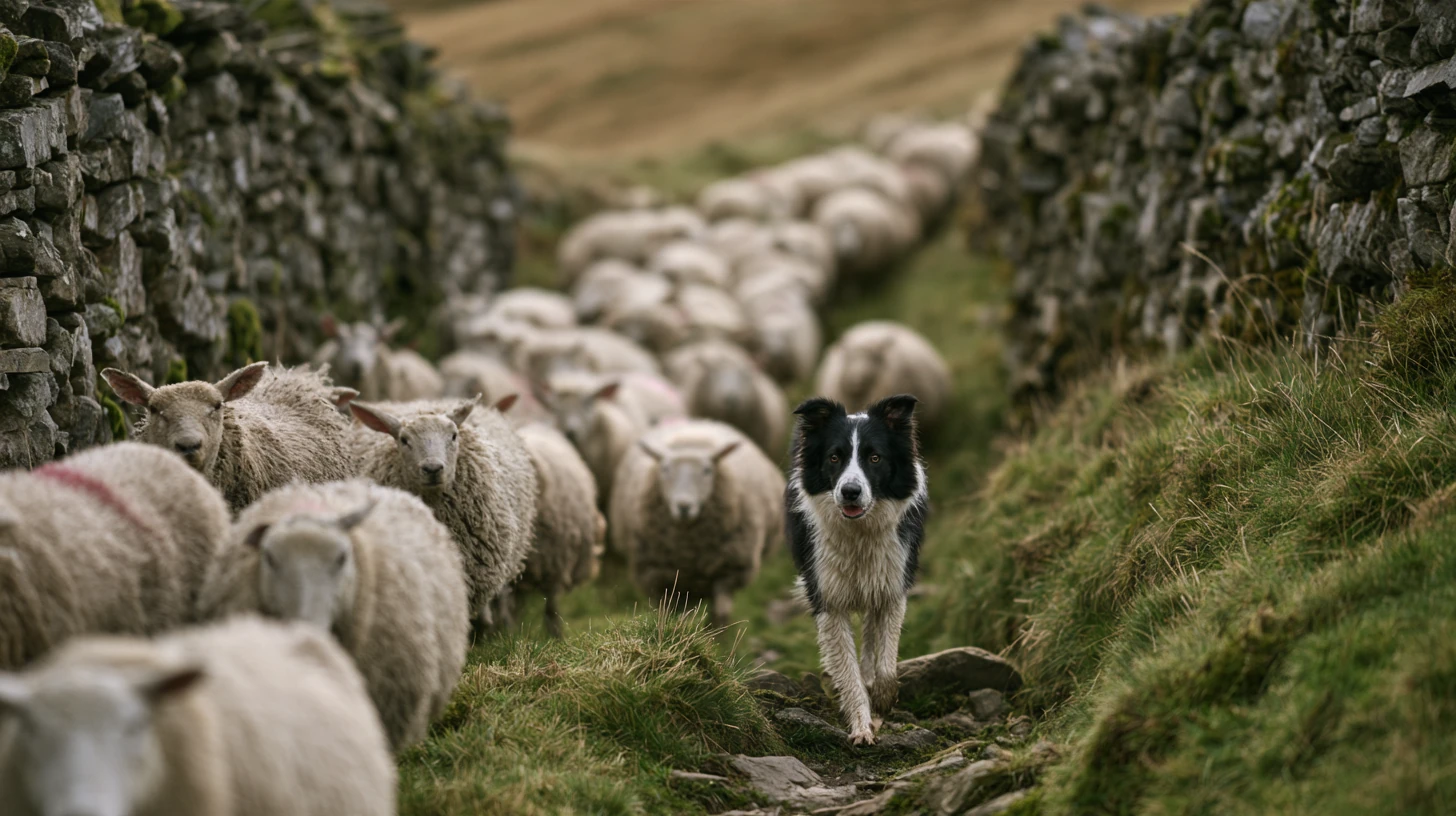
Breeders whose dogs work in farm and working dogs
About farm and working dogs
Britain’s farm dogs are the most tested working dogs in the country, judged on hillsides and in trial fields rather than in a ring. The International Sheep Dog Society (ISDS) has registered working Border Collies since 1906, sheepdog trials run every weekend of the season, and a small but growing number of holdings use livestock guardian breeds against foxes and loose dogs. This hub covers herding, droving and guarding dogs, and what a breeder can honestly say about them.
What this discipline is
Herding dogs move stock under a handler’s command: gathering sheep off a hill, driving them through gates, shedding single animals and penning. Droving and cattle dogs work closer and harder, often with a bark or a nip. Livestock guardian dogs (LGDs) do something different again: they live with the flock or the poultry, bond with it as puppies, and deter predators by patrolling, scent-marking and barking, without a handler present.
Sheepdog trials test the herding work. The ISDS runs National trials for England, Scotland, Wales and Ireland, the International, and a World Trial every three years; the 2026 World Trial was held in the Scottish Borders in September. Entry to the Nationals is earned through points at open trials during the year.
Who trains or supplies these dogs in the UK
Working sheepdogs are bred by shepherds and trialists and trained by their owners or by professional sheepdog trainers, who also sell part-trained and fully trained dogs. The ISDS registers more than 6,000 Border Collie puppies a year on behalf of its members, keeps a stud book with over 300,000 entries, and offers Registration on Merit for an unregistered dog that passes a working assessment, after which its progeny can be registered. The Society also publishes breeding and health requirements for the dogs it registers.
The Welsh Sheepdog Society, founded in 1997, registers the Welsh Sheepdog on working ability: breeding stock must be assessed in a working environment before progeny can be registered. Working Kelpies and New Zealand Huntaways are used on some British farms and have their own enthusiast networks.
Livestock guardian dogs in Britain are rare and mostly on smallholdings and poultry farms, guarding against foxes, badgers and corvids rather than the wolves they were bred for. There is no national body. Breeders of Maremma Sheepdogs, Anatolian Shepherd Dogs, Pyrenean Mountain Dogs and Estrela Mountain Dogs, and rescues such as Mastin Matters (Spanish Mastín), are the main sources. Anyone considering an LGD needs stock-proof fencing of five to six feet, shelter and shade, a plan for public footpaths (and in Scotland the right of responsible access), and patience: guardian dogs are not trusted alone with stock until they are around two years old.
Breeds and lines
The Border Collie is the herding dog of Britain, and the ISDS working dog and the RKC show Border Collie are now different animals; an ISDS number is the usual proof of working breeding. Other RKC pastoral breeds with real working history include the Bearded Collie, Welsh Corgi (originally a cattle dog), Old English Sheepdog and Shetland Sheepdog, though most are now companions.
The guardian breeds above are all recognised by the RKC. The traits that matter are calm confidence, low prey drive, strong bonding with stock and an inclination to stay within boundaries; the Spanish Mastín, for example, is reported to be less inclined to roam than some other guardian breeds.
Health testing for Border Collies covers hips, eyes and DNA tests for conditions such as collie eye anomaly and trapped neutrophil syndrome; the large guardian breeds need hip and elbow scores and, for some, heart and eye checks.
What a buyer should ask a breeder
- Are the parents ISDS-registered (or WSDS-registered) and can I see their trial record?
- Can I see the parents work stock, and what kind of stock and ground do they work?
- What health results do both parents have?
- For a guardian breed, were the puppies raised with livestock or poultry, and which?
- Do you sell part-trained or trained dogs, and can I see them working before I buy?
- Are you licensed by your council if your breeding requires it?
A farm dog is a working tool with a temperament. Buy from people who use their dogs, and be sceptical of anyone selling a “trained sheepdog” or “trained guardian” puppy.
What breeders can list here
Breeders may list their breed, ISDS or WSDS registration, trial results, health results, whether puppies are raised on stock, and whether they sell trained adults. They may not describe puppies as trained working dogs, and Canine Breeder does not supply or vet working dogs. This site is independent of the ISDS, the Welsh Sheepdog Society and every breed club.
If you breed sheepdogs, cattle dogs or livestock guardians that earn their keep, list your kennel in this discipline.
Breeds used for farm and working dogs
- Border Collie breeders
- Australian Cattle Dog breeders
- Lancashire Heeler breeders
- Cardigan Welsh Corgi breeders
- Pembroke Welsh Corgi breeders
- Smooth Collie breeders
- Old English Sheepdog breeders
- Whippet breeders
- English Springer Spaniel breeders
- Cocker Spaniel breeders
- Labrador Retriever breeders
- Jack Russell Terrier breeders
- Border Terrier breeders
- Maremma Sheepdog breeders
- Pyrenean Mountain Dog breeders
- Anatolian Shepherd Dog breeders